'You Don't Get to Censor Speech': Eric Schmitt Accuses Biden Admin of Social Media Censorship
Don't Miss An Update
Get the latest independent journalism from Alexandra Bruce delivered straight to your inbox.
No spam. Unsubscribe anytime. Your email stays private.
The Article
I'm hearing that some British creators and subscribers are fleeing Substack due to the platform's acquiescence to the tyranny of the UK's Online Safety Act (OSA), the analogues of which are also being rolled out in Australia and in the EU. If you are a resident of these countries, the simple act of reading a Substack chat now requires a full body cavity search of your entire Digital Twin.
Due to the fact that censorship is illegal in America, the workaround is "Freedom of Speech, not freedom of reach," as X.com ex-CEO Linda Yaccarino once said, which basically refers to shadowbanning – the kinder, gentler way to de-platform users.
Whereas, in the UK, they arrest 30 people per day for their tweets. In the US, we're just algorithmically un-personed, with no warning, no explanation and no recourse, millions at a time, as was my case on several major platforms in January of 2021.
Although President Trump has issued multiple Executive Orders during both of his administrations to end censorship and although the House Oversight hearings about the Censorship Industrial Complex did help to dismantle the State Department's Global Engagement Center (GEC), as well as the DHS' Disinformation Governance Board (DGB) – thus depriving Nina Jankowicz of a plum job violating your First Amendment rights as the head of a full-fledged US Federal Government agency – the sad fact is that censorship is very much alive in the US, because there are still so many Globalist traitors in the US Government and in Big Tech.
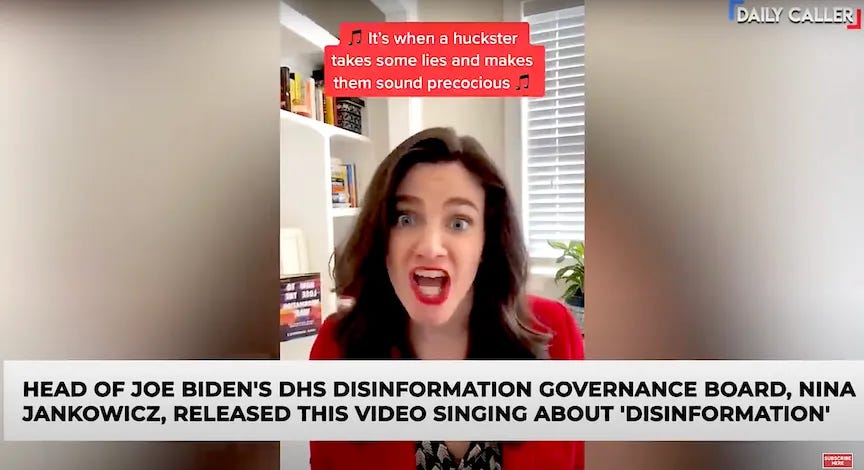
VIDEO: "Flashback: Ministry of Cringe!" - Pub. Aug 25, 2025 by ForbiddenKnowledgeTV.net
The Global Engagement Center GEC is the former censorship node within the State Department that collaborated with MI6 and a private company called NewsGuard to blacklist me and hundreds of other publishers from online advertising networks. NewsGuard targeted my website for destruction and has harassed me every year since 2021, exactly as described by PragerU’s Marissa Streit, here.
Hopefully, things are about to change on that front. On December 18th, Missouri Senator Eric Schmitt tweeted-out a thread about the existential threat posed by the censorship regimes of the UK, EU, Australia and Brazil, not just to their own citizens but to the citizens of the US.
Schmitt included this letter to the Under Secretary of State for Public Diplomacy Sarah Rogers, who assumed office two months ago, where he referred to Europe's growing online despotism as a "campaign of foreign subversion" that poses "a direct challenge to our sovereignty and independence as a nation."
His thread continues:
Over the past decade, we've seen alarming attacks on basic liberties across the West. In Europe, many governments have thrown their citizens in jail – sometimes for years at a time – for criticizing mass immigration, gender ideology, and various other parts of the left-wing program. [Like the Finnish MP who faces criminal charges for tweeting a Bible verse!]
Now, they're seeking to impose their censorship on Americans.
The internet is global. It isn't split into country-by-country silos. If an EU regulator makes a platform comply with its speech codes, those speech codes end up affecting everyone who uses the platform anywhere.So foreign bureaucrats are using extraterritorial leverage to impose a new global censorship regime. The EU's Digital Services Act (DSA) is the flagship model: it allows Brussels regulators to impose massive fines on any large platform that doesn't comply with their diktats.
This isn't abstract:The EU just fined X roughly $140 million. They claim it's about failing to comply with "transparency" rules, but that's a smokescreen. The rules are simply a tool the EU uses to punish pro-free speech platforms. The fine is a warning: Start censoring—or else.
And it's not just the EU. The UK recently passed its own DSA-style bill—the Online Safety Act—and its stringent censorship rules apply to all services that are accessible in the UK, even if the company isn't based there. Once again, companies that fail to comply face huge fines.
This, too, is not an abstract threat: Britain's online speech regulator, the Office of Communications (Ofcom), recently embarked on a campaign to enforce the Online Safety Act against Americans exercising their free speech rights here on American soil.
Australia's eSafety regime has done the same: demanding U.S. companies like X take action against posts by U.S. citizens on American soil—while threatening daily fines if they failed to comply.
They've also explicitly insisted X remove posts GLOBALLY; not just in Australia.And Brazil, too, has issued global takedown orders against online speech from users on U.S. soil.
But thankfully, this administration is fighting back. In July, the State Department imposed visa restrictions and sanctions against the Brazilian officials involved in these orders.Now, it's time to take further and more aggressive action to protect American speech and sovereignty.
Magnitsky Sanctions are some of our powerful tools to do just that—freezing the assets of foreign actors who violate basic rights and banning them from entering the U.S.In the past, the State Department has used Magnitsky Sanctions against foreigners in far-flung countries who attack the rights of their citizens.
In this case, they're waging a direct assault on not just their citizens, but OUR citizens, right here on our own soil.I'm also asking the State Department to consider visa and travel restrictions. As I noted in my letter, a who's-who of this cartel recently attended a pro-censorship conference at Stanford.
There's no reason we should let these people come to our country for strategy meetings.Some of these foreign censors are currently residing in our country. Imran Ahmed—the British Labour Party operative who founded the Soros-funded Center for Countering Digital Hate (CCDH)—is reportedly here on a visa. The State Department should revoke it. He needs to go back.
Left-wing activist NGOs like CCDH are malignant actors, and play a similar role to the left-wing anti-"hate" groups that have gone after X and @elonmusk here in America. They have played a critical part in this global censorship enterprise, and should face the same consequences.
Under President Trump's leadership – and thanks to the incredible work of patriots like @UnderSecPD, who I met with to discuss these issues before her confirmation earlier this year—the State Department has staked out a strong pro-sovereignty, pro-free speech posture in the world.
Now, it's time to build on its successes and go further.
You can read my full letter here.
Schmitt concludes his letter to Rogers by asking, "1. Does the State Department have the statutory tools it needs to combat this foreign censorship threat, or are additional authorities needed? 2. Are any additional legislative solutions needed to help the United States combat the global censorship-industrial complex's threat to American free speech and sovereignty?" It looks like Schmitt, Rogers and the State Department mean business.
During Tore Maras' three-hour December 15th podcast, she described looking at the 2026 NDAA, which is the Pentagon’s budget for next year and she assessed that the Global Engagement Center had been quietly resurrected and funded in the final amendment of the National Defense Authorization Act for Fiscal Year 2026, which was signed into law on December 18, 2025.
Tore said that while that GEC was dissolved, its functions had now been funneled primarily through the Office of the Under Secretary of State for Public Diplomacy.
That office is now headed by Sarah Rogers, the Free Speech activist, who is highly praised by Senator Schmitt in the X.com thread above, calling Rogers a "patriot" who's advancing the State Department's "strong pro-sovereignty, pro-free speech posture in the world."
It appeared to Tore, perhaps without knowing more about Sarah Rogers, that the way the NDAA was written told her that Congress believes that censorship and influence operations are part of modern warfare and that they don't want a civilian-facing office that looks like it manages speech, because they don't want us to know that they're managing speech (because censorship is illegal).
She said this is why she thinks it would be important for President Trump to make an agency that is in charge of these things, so that it can be subject to oversight.
It seems to me that the appointment of Rogers was a very strategic one to handle this censorship war with the decrepit tyrannies of the EU and the British Commonwealth. This isn’t a permanent solution, it's the Trump administration's response to the current asymmetrical lawfare attacks on the US.
At the end of all of this, I would like to see an internet bill of rights that is based on the US Constitution. This is what my late friend, John Perry Barlow championed and it's why he became a Berkman Fellow at Harvard University.
Horribly, the Berkman School has devolved into nest of the same censorship cartel that recently met at the Stanford Internet Observatory, that Schmitt refers to in his X thread.
If the Europeans prefer to be jailed for their tweets, then I guess the only answer is to terminate their access to US internet infrastructure.
Alexandra Bruce
Publisher of Forbidden.News and curator of independent investigative reporting focused on censorship, geopolitics, and stories overlooked by mainstream outlets.