
While You Watched Venezuela, Trump Quietly Put Canada on Notice
Don't Miss An Update
Get the latest independent journalism from Alexandra Bruce delivered straight to your inbox.
No spam. Unsubscribe anytime. Your email stays private.
The Article
Susan Kokinda has knocked it out of the park, again. Her succinct presentation in yesterday's Monday Brief is perfection. She explains how President Trump's recent operation in Venezuela was actually "a surgical strike against the British Empire's irregular warfare", a key component of which is the nexus of narcotics trafficking, terrorism and the City of London-centered banking system.
The British Empire of today is no longer one of geographical colonies, it is the world's post-WWII financial system that is propped-up by the Globalist "Rules Based Order".
Britain's network of banks domiciled in the City and in the "secrecy jurisdictions" of former British colonies are what filmmaker Michael Oswald calls "Britain's Second Empire".
Oswald's highly-instructive 2017 film, 'The Spider's Web' was produced for only £4,000 but it contains much higher quality information than any documentary about finance that you will ever see produced by an establishment media outlet. The film is very much worth your time, if you haven't seen it.
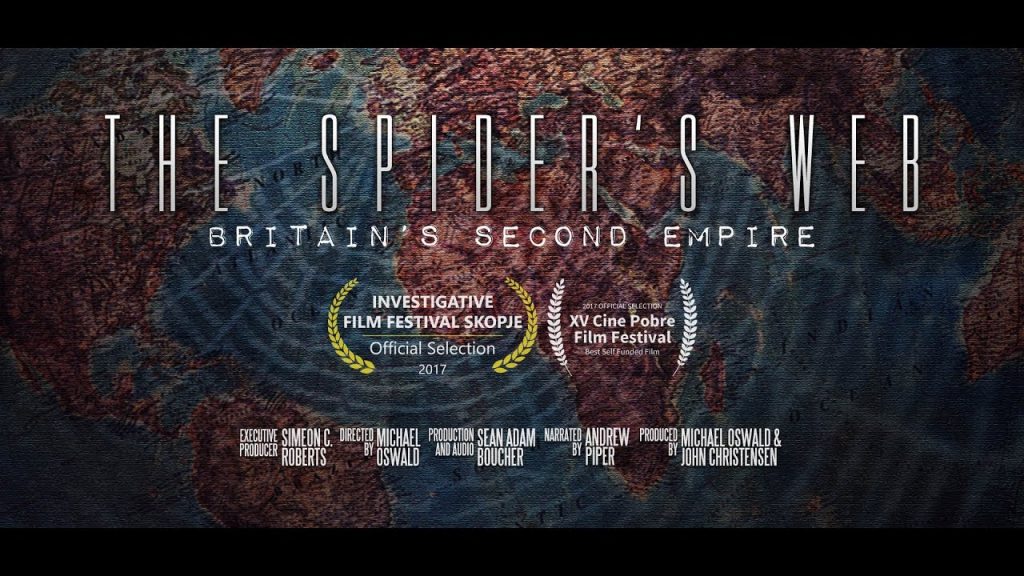
FEATURE FILM: 'The Spider's Web: Britain's Second Empire' (2017) - Pub. Sept 18, 2018 by ForbiddenKnowledgeTV.net - Excellent, super-important film about the history of offshore banking.
As the British Empire collapsed in the 1950s, financial institutions found that by claiming to operate within the tiny jurisdiction of the Corporation of the City of London, they could circumvent the regulation and taxation of the UK.
When American banks understood that the City allowed them to avoid US regulations, they were quick to move their international operations there and within half a century, it had become standard practice for large corporations to leverage and to outsource not just their financial assets but their operations, in order to skirt the laws and taxes of their home jurisdictions.
The mid-century banks set up the Euromarket, where currencies from outside their countries of issue were held and traded and called "eurocurrencies". The eurocurrency market developed into the major source of finance for international trade we know today, because of the ease of convertibility and the absence of domestic restrictions on trading.
In the 1960s, the City of London's model was replicated in the last remaining territories of the Empire. Accountants and lawyers from London descended upon these British dependencies and cobbled together "secrecy jurisdictions". Of the 14 overseas remnants of the British Empire, seven of them, including Cayman Islands, Bermuda and the British Virgin Islands are the biggest tax havens in the world today, that are just a stone's throw away from Venezuela.
As British financial investigative journalist, Nicholas Shaxson explains in 'The Spider's Web', "What the Cayman Islands was doing was straightforwardly illegal activity; drug money was coming in in huge quantities; tax evasion, whatever you wanted, you could have it."
The Bank of England observed these developments from London and determined that as long as UK capital wasn't transferred to the non-Sterling area outside UK rules, they didn't mind. Their aim was to create offshore centers with strong secrecy legislation in order to attract capital from across the globe.
This lawlessness inevitably attracted all of the unsavory elements that one could imagine, like the Pakistani Bank of Credit and Commerce International (BCCI), which was eventually accused of opening accounts or laundering money for figures such as Saddam Hussein and Manuel Noriega and for criminal organizations, such as the Colombian Medellín drug cartel and for the terrorist, Abu Nidal.
Police and intelligence experts nicknamed BCCI the "Bank of Crooks and Criminals International" for its penchant for catering to customers who dealt in arms, drugs, and hot money. The Central Intelligence Agency held several accounts at BCCI. According to a 1991 article in Time magazine, the National Security Council also had accounts at BCCI, which were used for a variety of covert operations, including transfers of money and weapons for Iran-Contra.
Shaxson says, "Another kind of secrecy, which is very British is the trust…a very slippery, complicated and devious mechanism." Trusts keep assets at arm's length from their owners, removing from them any responsibility for any taxes associated with their properties. Trusts are the building block of Anglo-Saxon secrecy.
John Christensen, who for ten years was an economic adviser to the secrecy jurisdiction of Jersey in the Channel Islands estimates, "Trillions of dollars of capital…apparently belong to nobody for tax purposes and for other purposes…Everything; works of art, gold bullion, racehorses, real estate…belong to these trusts sitting there, belonging to nobody. Now, think that one through. We are talking about maybe as much as $50 trillion of assets sitting offshore behind these instruments.
"When countries complain to Britain about the activities run out of its offshore havens, Britain claims that these places are independent and that there is nothing it can do…they don't have the powers to intervene. Well, that's a straightforward lie. They do have powers to intervene, they just choose not to…I see these [offshore tax havens] as the Frankensteins created by the City of London."
The saddest consequence of all of this is its effect on developing world nations. In 2008, the debt of Sub-Saharan African nations stood at $177 billion dollars. Yet, the wealth these country’s elites had moved offshore between 1970 and 2008 is estimated at $944 billion – over five times their foreign debt. Christensen says, "Do the maths! Far from being a net debtor, Sub-Saharan Africa is a net creditor to the rest of world!"
Shaxson says, "In developing countries, the offshore system of tax havens has facilitated the looting of these countries by their elites. It has enabled them to steal the money and keep it safe somewhere else."
Alex Cobham of the Tax Justice Network explains, "Illicit financial flows – the anonymity that drives them creates incentives for people in positions of power to be corrupt. This is why there's a group of countries where developmental progress is so difficult."
Worldwide, developing countries lose over $1 trillion dollars every year in capital flight and tax evasion. Most of this wealth flows into large Western nations, like the United States and Britain and enables their currencies to stay strong while developing nations' currencies remain weak.
TRANSCRIPT
Susan Kokinda:While the entire world is focused on Venezuela and Mexico and Cuba and Colombia, Donald Trump just quietly put Canada in the hot seat. Why? Because the operation in Caracas isn't just about Maduro. It's an opening salvo against the British Empire. Here's what the President said:
(Roll video)
President Trump: So we have to do something because we lost, the real number is 300,000 people in my opinion. You know, they like to say 100,000. 100,000 is a lot of people, but the real number is 300,000 people and we lost it to drugs and they come in through the Southern Border, mostly the Southern Border. A lot, plenty come in through Canada too, by the way, in case you don't know.
Susan Kokinda:But you're not supposed to notice that. The headlines covering that same press conference are focused on the usual targets, like this one in The New York Post. But while the Empire's American propaganda arms want you focused on those usual suspects, by Sunday, the Canadians had figured out what I just told you. The editorial board of the Toronto Globe & Mail announced in their Sunday editorial that Venezuela's fate is a warning to Canada.
Meanwhile, the rest of the narrative is being played out by the press, like The New York Times, which says that this is another regime change operation out of the Bush playbook and that it's going to split the MAGA movement. And of course, The New York Times' favorite new political figure, Marjorie Taylor Greene, played her part in feeding into the MAGA split narrative. Meanwhile, the Democratic Party is playing its assigned role in the narrative, shrieking about Trump's actions and some are already calling for his impeachment.
But here's where it gets interesting. Some of Trump's opponents, like the former head of Britain's MI6 and Walrus Man, John Bolton, immediately recognized that what the US did in Venezuela was not a regime change operation. They're actually on to something.
It isn't regime change. It's a surgical strike against the British Empire's irregular warfare and a key component of that, which we have long called "Dope Inc.", the nexus of narcotics trafficking, terrorism, and the City of London-centered banking system. And today, we're going to break that down.
I'm Susan Kokinda. I've been tracking this since the 1970s, watching how the offshore banking operation was set up to sidestep regulation, sovereignty, and law enforcement. And I'm here to tell you that for the first time, someone is taking that on, and it's Donald Trump.
So if this sounds like your kind of fight, please hit those like, share, and subscribe buttons so we can reach more people. Here's what we're going to cover today.
First, it's not regime change – and the Empire knows it. Second, how the Empire's operations of dirty money is now in the crosshair – and the Russians know it, and how Trump is deploying to defeat all of these imperial operations.
So let's clear up the biggest misconception, right now. Many former MAGA allies, Candace Owens, Marjorie Taylor Greene, are screaming that this is "Neocon regime change 2.0". They're just looking at the surface or outright lying.
But listen to Secretary of State Marco Rubio. He told us exactly what this is.
(Roll video)
Kristen Welker:I want to start with this big picture question: Is the United States now at war with Venezuela?
Marco Rubio:There's not a war. I mean, we are at war against drug-trafficking organizations. It's not a war against Venezuela. You cannot continue to have the largest oil reserves in the world under the control of adversaries of the United States, not benefiting the people of Venezuela and stolen by a handful of oligarchs around the world, including inside of Venezuela, but not benefiting the people of that country.
Susan Kokinda:Did you catch that? He didn't blame socialism. He didn't blame communism. He blamed oligarchs and drug-trafficking organizations.
Now, that takes us back to Trump and his targeting of Canada, which no one seems to want to talk about. Because when you put the words "oligarchs" and "drug-trafficking organizations" in the same context, you aren't just talking about the cartels in Mexico or Colombia.
You're talking about key characteristics of the British Empire, which is the epitome of oligarchy, or to put it another way, the "rule of the few", which is what oligarchy means. And when it comes to drug-trafficking organizations, the British Empire has been the most notorious entity in the world, when it comes to making money off of drug-trafficking, going back over 200 years, including the notorious Opium Wars of the 19th century.
This has never stopped. It's just taken a new form. And that's the importance of Canada in this picture. It is run by the Empire's favorite central banker, Mark Carney, and it is the major political outpost for the crown in North America, used for drug trafficking, as the president mentioned, illegal immigration, and terrorism.
Unlike, say, someone like Mexican President Claudia Sheinbaum, whom Trump accurately characterized as "terrified of the cartels", Carney has actually facilitated the financing arm of the cartels in his former role as the head of the Bank of England.
While no one else is picking up on the Canada angle, some interesting folks who are not exactly Trump supporters are picking up on another aspect of this, on the fact that what the US did in Venezuela is not "regime change". Let's start with the former head of MI6, Sir John Sawers.
He isn't clutching his pearls about "democracy". He recognizes this for what it is. What Trump did is a demonstration of raw power that bypasses the Empire's rules-based order.
(Roll video)
John Sawers:Well, first of all, I think I'd be cautious about using the phrase "regime change". The Americans have abducted the leader of Venezuela, Maduro, and taken him to the US to stand trial. But they are now already dealing with the regime. The army remains in power. The legal structures of the regime remain unchanged. And they're already talking to Delcy Rodríguez, the vice president who's been sworn in as the new president of Venezuela, and distance themselves from the opposition.
So, this isn't the sort of regime change of the sort that we saw in Iraq. And it's commensurate with the clear reluctance by Trump to put large-scale forces on the ground.
Susan Kokinda:Sir John admitted this operation is new territory. He noted that Washington is already dealing with Maduro's successors and that the structures of the country remain. He knows this isn't Iraq. It isn't Tony Blair's regime change. It's something else. And he's not alone. Here's John Bolton.
(Roll video)
John Bolton:But let's be clear. There's a big difference between getting Maduro and removing the regime. Right now, facts are scarce, that's for sure. But the regime is still in power. And Trump, inexplicably today at his news conference, took a shot at the Nobel Peace Prize-winning leader of Venezuela's opposition, Mrs Machado; said she didn't have the trust of the Venezuelan people. So I think there's a lot of lack of clarity, to say the least, in Trump's thinking on this. And it would be a hollow victory, indeed, if we snatched Maduro but left his regime in place.
Susan Kokinda:When MI6 and John Bolton are admitting that this is not standard regime change and Trump's allies are confused, you know you're watching a higher level of warfare. And this is exactly why you need to be plugged into Promethean Action.
While so-called MAGA influencers are screaming "regime change", but the former head of MI6 is calmly explaining that this is something entirely different, who do you think actually understands what's happening?
We've been tracking British imperial operations and irregular warfare for decades. We don't react. We don't chase headlines. We understand the enemy's playbook, because we've studied it and fought it since the 1970s. So, if you're tired of being confused by people who you think are on your side, subscribe to our free newsletter at Promethean Action. We'll help you see what Trump is actually doing, so you can defend it and explain it to others. So head on over to Promethean Action and subscribe to our free newsletter.
Now, here's what Trump is really going after: If this is a war on drug-trafficking organizations and oligarchs, as Rubio says, then it is automatically a war on the global banking system, because you can't separate the two.
The target isn't just jungle labs and drug boats. It's the City of London. Let's remember where Venezuela is. It borders the Caribbean. What else is in the Caribbean? The origin point for the infamous system of offshore banking, established directly by the British.
Back in 1960, the largest banking houses in London, working in partnership with the Government and the Exchequer, established 14 completely secretive secrecy jurisdictions. These are the offshore banking centers that now hold between $50- and $75 trillion, with all 50 of the world's largest banks operating within them. These offshore centers exist outside the control of sovereign governments. They're secret, they're unregulated, and they facilitate illegal activity.
What we once had, a legitimate regulated banking system, has been transformed into a criminal enterprise. And interestingly, the Russians have known this for years and have been more vociferous about it than any Western government.
In a 2014 speech, Viktor Ivanov, then Russia's top drug enforcement official, laid it out clearly in a Moscow conference. He said, "This allows us to confidently assert that narco money is the foundation of the modern financial system. It is not surprising that during the first peak of the financial crisis of 2008-2009, Antonio Costa, from the UN, announced that the top banks in the world dumped in around $352 billion of narco dollars to use for interbank borrowing to address the critical shortage of liquidity."
And he goes on to make clear that the global financial system needs drug money to survive:
"The very existence of the global financial bubble, he said, is based on precisely this opportunity for banks to attract liquid narco money. In fact, this garbage fertilizes the present economic system."
Now, this is a good time to remember that Treasury Secretary Scott Bessent recently commented that 50% of his job involves issues of National Security. Now, think about it. Since we started targeting drug boats and lighting-up the communications channels of the cartels and their financiers, I bet Treasury Secretary Bessent has been just as busy as Pete Hegseth!
Now, Venezuela doesn't have to be a major producer of drugs. It's the facilitator for the spider web of narcotics, illegal immigration, and terrorism. And it's well known that Hamas, Hezbollah, and the Iranian Revolutionary Guard operate out of Venezuela.
So think about the implications. Trump's moves on Venezuela hits at this nexus, and it effectively attacks the liquidity of the offshore banking system established by the British in the 1960s. He's cutting off the flow of fertilizer to the Globalist oligarchs.
And this brings us to the real issue, which is the fact that we are fighting not regular warfare, but irregular warfare: For decades, the British Empire and Globalist banks have waged war on us using non-state actors, NGOs, terrorists, cartels, all of which are protected by their "Rules-Based International Order". A couple of my friends discussed this when they summed up their discussion on Venezuela. Here's what Crypto Rich and Tom Luongo said:
(Roll video)
Crypto Rich:So here's Trump coming along, breaking the rules, which he has to do, in order to defeat the international banking cartel, which is spawned out of the City of London.
Tom Luongo: Well, you can't play by their rules when their "Rules-Based Order" is all based on – It favors them. And it favors them. They set the game board up. And if you want to beat somebody, you can't play the game by their rules. Basic Sun Tzu. "Never fight on a ground prepared by your enemy."
Susan Kokinda:Tom's right. You can't defend your nation if you play by their rules. And the new National Security Strategy, which Rubio brought up in the above interview, says so. Just a reminder, here's what the National Security Strategy says about the elites' rules:
"...they lashed American policy to a network of international institutions, some of which were driven by outright anti-Americanism and many by a transnationalism that explicitly seeks to dissolve individual state sovereignty."
Susan Kokinda:So on behalf of all sovereign nations, Trump has taken the fight directly to those institutions, both the so-called legitimate ones like USAID, the NGOs, the nonprofits, the universities and the illegitimate side, the cartels, the criminal empires, and their financiers. We're no longer playing by the rules of the rules-based order. And don't forget, it was Canada's Mark Carney who said that just a few months ago:
"The old world of steady expansion of rules-based liberalized trade and investment...that world is gone."
Susan Kokinda:This is what this administration is taking on in their whole-of-government approach. No, it isn't "regime change". It's the recognition that this is irregular warfare. And for the first time in the entire post-war period, the United States is actually fighting back.
So here's the bottom line. While the talking heads and influencers are screaming about "regime change" and splitting MAGA, Donald Trump just declared war on the financial backbone of the British Empire. He's targeting the offshore banking system that has funded terrorism, cartels, and the destruction of sovereign nations for over 50 years. And he's just targeted Canada for good measure.
The most ironic part? The enemy understands what Trump is doing better than many of his supposed allies. Sir John Sawers and John Bolton see it. And one of the other superpowers, Russia, has been warning about this for decades.
But too many in the MAGA movement are stuck arguing about whether this is another Neocon regime change, instead of recognizing that Trump has just launched the biggest offensive against the City of London since, maybe the American Revolution.
This is why we exist. Promethean action has been in this fight since the 1970s. We've exposed the offshore banking apparatus. We've been warning about British irregular warfare, when everyone else thought we were crazy. Now, Trump is doing what we've been advocating for decades. And we're here to make sure that you understand it so that you can defend it and amplify it.
Go over to the Promethean Action website and subscribe to our free newsletter, become a paying member, support us financially, and check out our resources. This has been your Monday Brief.
Voiceover:Thanks for watching. Please take a moment and subscribe to our free newsletter at PrometheanAction.com.
Alexandra Bruce
Publisher of Forbidden.News and curator of independent investigative reporting focused on censorship, geopolitics, and stories overlooked by mainstream outlets.