
A truism widely attributed to Albert Einstein is that “No problem can be solved from the same level of consciousness that created it”. This sums up the need for a shift in perspective when facing challenges, because the mindset, assumptions, and habits that led to a problem are typically what keep it in place.
Our assumptions, in turn, are reinforced by a relentless bombardment of propaganda and by a suppression of science by the Powers That Be.
In short, we have been dumbed-down but being that Quantum Mechanics was developed over 100 years ago, it’s a good idea to apprise yourself of the basics, which I’ll try to do now, as I was lucky enough to be commissioned to write a book about it 20 years ago, ‘Beyond the Bleep’, which includes a chapter on Stuart Hameroff, MD.
Stuart Hameroff is a leading expert in anesthesiology, consciousness studies and quantum biology and he appeared on the Danny Jones Podcast last January. In the clip above, he explains why computers will never be able to replicate consciousness.
Hameroff talks to Danny about how consciousness requires non-computable quantum effects tied to the fundamental structure of spacetime, making it impossible for conventional computers to achieve true awareness. He delves into the role of microtubules, Objective Reduction in Quantum Mechanics, and how these enable qualities like understanding, free will, and subjective experience that AI lacks.
The materialism that has reigned supreme during the past 500 years says that matter is the fundamental substance of the universe; that all things, including mind and consciousness arise from material interactions.
Dissatisfied with this prevailing scientific view of consciousness as no more than a biological form of computation, renowned English physicist Sir Roger Penrose turned to the Hard Problem of Consciousness, arguing that nerve cells are too big to be the source of consciousness; that consciousness must be a subatomic phenomenon.
Together with Stuart Hameroff, MD, Penrose devised a Unified Field Theory in formulating the Orchestrated Objective Reduction (Orch-OR) model of consciousness.
As an anesthesiologist, Stuart had observed daily how anesthesia targets consciousness by acting on neural microtubules. He postulated that consciousness originates at the quantum level inside neurons, rather than being a product of neural connections. He proposed the mechanism to be a quantum process called Objective Reduction, which of course, engendered a lot of interest and severe criticism.
Dr Stuart hameroff is one of the stars of the new indepdent feature film, ILLUSION, which premieres today and which you are invited to view for free starting now through 11:59 PM Eastern Time Sunday, July 26th before the viewing window closes, by clicking the banner below.

Watch ILLUSION for Free!
ORCHESTRATED OBJECTIVE REDUCTION
I will attempt to explain Objective Reduction in the simplest terms and the implications of this theory, which Hameroff and Penrose concocted together. Don’t be intimidated by it. Just read it.
The famous Double-Slit Experiment demonstrates that light and matter can exhibit behavior associated with both classical waves and classical particles. In quantum theory, waves collapse into particles when they are observed. This is called Wave Function Collapse, aka Reduction.
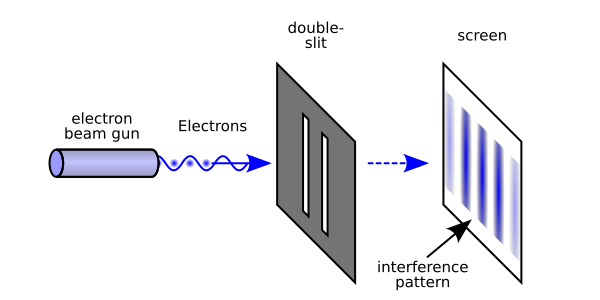
IMAGE: The Double Slit Experiment: Photons or matter (like electrons) produce an interference pattern when two slits are used.
The traditional view of how quantum wavefunctions “collapse” or “reduce” into the classical state of seemingly solid, “linear” phenomena is called Subjective Reduction. In this model, collapse can occur either by conscious observation, measurement or environmental “entanglement,” resulting in a statistical projection of the given particle’s location.
Penrose proposed that a new physical ingredient was needed: Objective Reduction, in which coherent quantum systems can “self-collapse” upon reaching a critical mass/time/energy threshold related to Quantum Gravity. In the Penrose-Hameroff model, consciousness does not cause collapse of the quantum wave function. Rather, consciousness is collapse.
Quantum Gravity describes the interaction of gravity with the three other fundamental forces of electromagnetism, the strong nuclear force and the weak nuclear force. Gravitation is the tendency of masses to be attracted to each other.
Electromagnetism is the physics of the electromagnetic field. Both the strong and the weak nuclear forces are short-range forces, limited to distances shorter than the nucleus of an atom. The residual effects of the strong nuclear force bind neutrons and protons together in the nucleus of an atom. The weak nuclear force has a field strength that is 109 times weaker than the strong nuclear force and is present in radioactive decay.
But what is consciousness? According to the principles of Orchestrated Reduction (Penrose, 1994), superpositioned states each have their own space-time geometries. When the degree of coherent mass-energy difference leads to sufficient separation of space-time geometry, the system must choose and decay (reduce, collapse) to a single universe state, thus preventing “multiple universes” (e.g. Wheeler, 1957). In this way, a transient superposition of slightly differing space-time geometries persists until an abrupt quantum classical reduction occurs and one or the other is chosen. Thus consciousness may involve self-perturbations of space-time geometry.
SUBJECTIVE REDUCTION VS. OBJECTIVE REDUCTION
In the traditional quantum theory of Subjective Reduction, a system is in a superposition of possible states until observed, causing it to collapse; in Objective Reduction, the superpositioned states each have their own bubble-like space-time geometries, which are unstable and will self-collapse into one particular curvature/separation when the warping of these space-times reaches an objective quantum gravity threshold.
The larger the bubble-like separation/superposition, the faster it will self-collapse – and the more intense the conscious experience, because in the Objective Reduction model, consciousness is seen to be an aspect of wavefunction self-collapse, via quantum gravity.
Microtubules are made up of tubulin molecules. The Penrose-Hameroff model proposes that internal quantum events occurring within tubulins, in cooperative interaction with each other are the bridge between subatomic quantum events and molecular, “classical” reality. Each self-collapse corresponds with a distinct conscious event, which occur on average 40 times per second:
“Microtubule subunits (tubulins) are coupled to internal quantum events, and cooperatively interact (compute) with other tubulins. We further assume that macroscopic coherent superposition of quantum-coupled tubulin conformational states occurs throughout significant brain volumes and provides the global binding essential to consciousness. We equate the emergence of the microtubule quantum coherence with pre-conscious processing which grows (for up to 500 milliseconds) until the mass-energy difference among the separated states of tubulins reaches a threshold related to quantum gravity.”
Sequences of such events create a stream of consciousness. The Objective Reduction is “tuned” by the cell’s microtubules and is thus self-organized, or “orchestrated”:
Possibilities and probabilities for post-reduction tubulin states are influenced by factors including attachments of microtubule-associated proteins (MAPs) acting as “nodes” which tune and “orchestrate” the quantum oscillations.
In addition, “pre-conscious” information is seen to be encoded in space-time geometry at the fundamental Planck scale. Different kinds of conscious experiences correspond to various configurations of quantum spin geometry. Consciousness, as we know it occurs when a self-organizing process (the objective reduction) accesses these pre-conscious states.
Of course, not everyone agrees with this theory but at least now, you have some background on Stuart Hameroff, MD, who stars in the new independent film, ILLUSION, which premieres today and which you are invited to view for free starting now through 11:59 PM Eastern Time Sunday, July 26th before the viewing window closes.

Watch ILLUSION for Free!