
The first round of Brazil’s general elections between 12 candidates are being held today amid rumors of a possible coup.
Last Friday, the Brazilian Federal Police executed two search and seizure warrants in São Paulo and in a suburb of Brasília, responding to to tips from foreign intelligence agencies and to reports from US diplomatic staff of receiving threats linked to the election. Agents seized computers and cell phones for forensic examination.
Secretary of State Marco Rubio ordered the immediate suspension of in-person services at the US Embassy and consulates in Brazil and employees were instructed to work from home.
The State Department only does this when there’s war, as happened in Afghanistan in 2021, in Ukraine in 2022, in Sudan in 2023 and in Israel in 2024.
The Brazilian TV network, Band reported that the FBI was monitoring potential attack plots targeting the US Embassy and consulates in Brazil ahead of the elections, adding that this information had been shared with allied governments.
Australia followed the US’ lead in closing its consulates and Germany, Canada, Ireland and the UK issued travel alerts about Brazil – all of which is unprecedented.
Brazilian authorities reported that no evidence to corroborate the initial risks has been found and no suspects had been found to have ties to organized crime or criminal syndicates.
The sudden embassy closures fueled an incredibly tense pre-election atmosphere. Local intelligence elements, including the Brazilian Intelligence Agency (ABIN), have expressed concern over the timing of the US closures, with some internal political factions examining the move as part of potential PSYOP or foreign interference ahead of the high-stakes presidential election.
President Lula da Silva’s recent speech at the UN warned of foreign interference in Brazil’s upcoming elections and his leftist Worker’s Party (PT) has persistently fostered a narrative about this, with his campaign requesting that the Supreme Court and the Superior Electoral Court investigate this, leading Flávio Bolsonaro’s campaign to raise concerns that if he wins, he’ll be accused of “foreign interference”.
Let’s not forget that in 2022, the Biden administration sent National Security Advisor Jake Sullivan, Secretary of Defense Lloyd Austin and CIA Director Bill Burns on separate visits to browbeat President Jair Bolsonaro into accepting the results of the upcoming election and that nobody in Brazil’s Deep State said a thing about “foreign interference” then.
In the run-up to the election, Lula refused to appear in a televised debate with the other candidates, leading to the debates’ cancellation by the broadcaster, Globo. Additionally, the Superior Electoral Court has refused to allow international observers at this election.
During the past month, the polling has tightened substantially, with Polymarket currently indicating that Flávio Bolsonaro will win a runoff between himself and Lula later this month.
When this shift became apparent, Lula banned online betting – which he, himself had only just legalized!
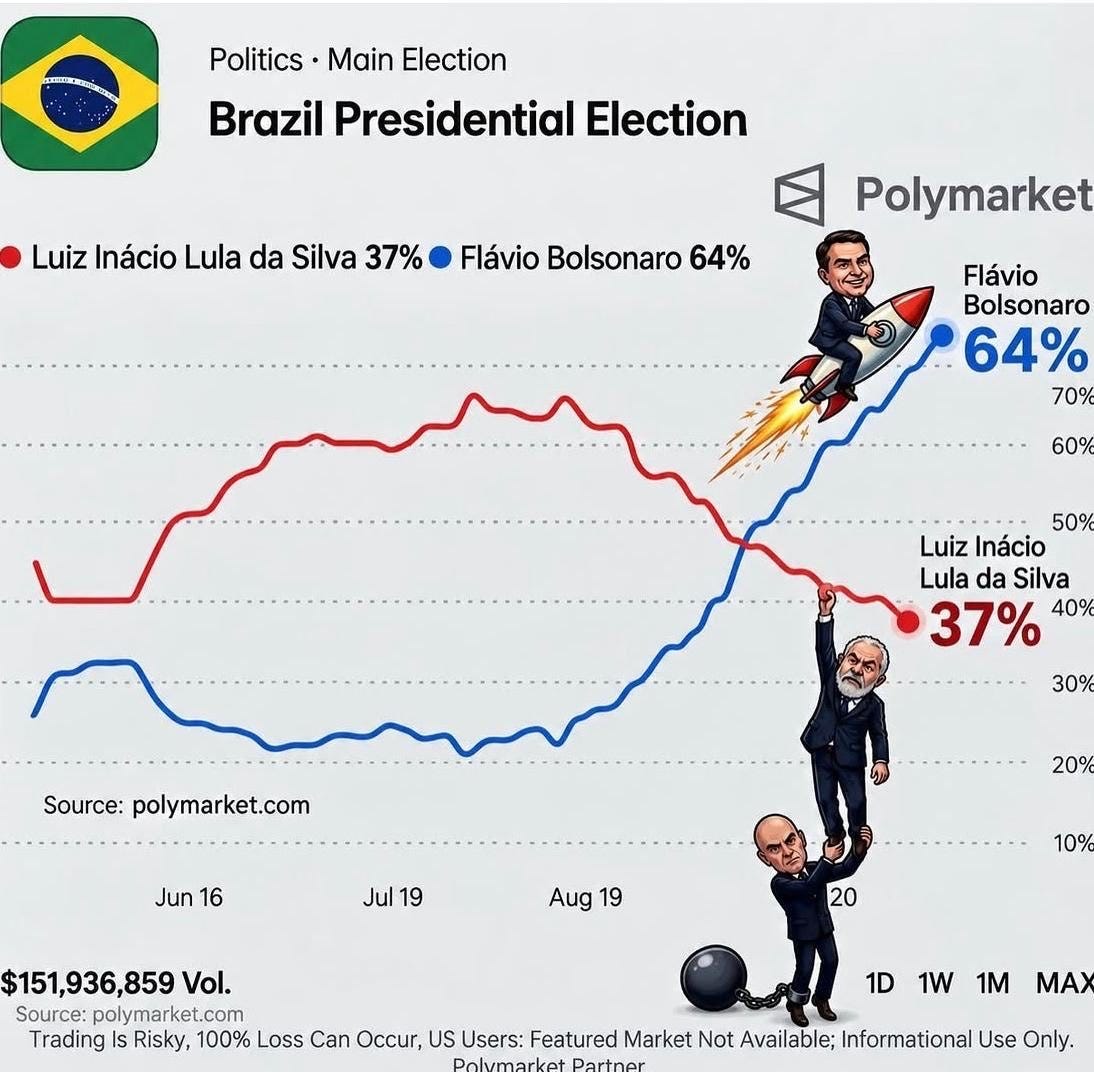
IMAGE: Polymarket results for Brazil’s 2026 election.
In Brazil, some fear that if Flávio Bolsonaro wins the election, the corrupt judiciary will nullify the results, triggering a US invasion. These fears were bolstered by a tweet from the US Southern Command on Friday that within 18 hours, they could “Strategically conduct forcible entry parachute assaults and secure key objectives anywhere in the world – making it clear that our reach is absolute and our response is immediate throughout the #SOUTHCOM area of responsibility.”
On his podcast last Friday, respected investigative journalist, Claudio Dantas stated that military officials had warned Supreme Court justices not to count on them if any actions they take trigger an institutional crisis or foreign intervention.
Dantas advocated for the Supreme Court to respect the popular will, the law, and the constitution and to resolve problems domestically so as not to give anyone a pretext for an intervention, saying, “When an outside party comes to solve our problem, they don’t come to resolve issues based on Brazilian interests, but rather their own interests,” citing the situation in Venezuela.
Ironically, it was Brazil’s Supreme Court that ruled in 2024 that the Brazilian constitution does not allow the military to intervene in politics under any circumstances, in what was then seen as a rebuff of former President Jair Bolsonaro.
This appears to diverge from US Law, in which there are exceptions, exclusions, and limitations to the Posse Comitatus Act.
Lula was released from prison by Supreme Court justice Edson Fachin in 2019 – eleven years ahead of his sentence for accepting $1 million in bribes and for money-laundering. Ever since Lula was re-installed as President in 2023, following the apparent theft of the 2022 election using Brazil’s Diebold-based electronic voting system that uses Smartmatic technology, the Iranian-Lebanese terrorist organization Hezbollah has proceeded run amok in Brazil, trafficking drugs and laundering money through Brazil’s remote border regions with Argentina, Paraguay, Bolivia and Venezuela.
As with Venezuela’s Tren de Aragua (TdA) gang, Hezbollah has been training and arming Brazil’s largest organized crime syndicates, Comando Vermelho (CV) and Primeiro Comando da Capital (PCC).
The PCC runs drugs throughout South America, West Africa and Europe, with a yearly revenue of over $900 million and nearly $6 billion in property investments. In 2023, The Economist reported that the PCC is currently transitioning into a global mafia by penetrating the legal economy and by influencing local politics in the numerous countries where it is active.
The day before Lula’s May 7th meeting in the Oval Office with President Trump, the White House released their 2026 Counterrorism Strategy, which on page 10 describes the alliances of Latin American cartels with Hezbollah and how the Trump administration intends to:
“Take whatever action is necessary to protect our country, especially if the government in question is complicit with the cartels. Under President Trump, the United States will continue to dismantle the cartel networks and disrupt their recruiting and funding streams until they are neutralized and the regimes who helped them are no longer able to do so.”
This was likely a topic of their meeting, after which Lula canceled the follow-up press conference and immediately jumped on his plane back to Brazil.
Three weeks later, the US Government designated both the PCC and the CV as FTOs. In response, Brazil’s Ministry of Foreign Affairs issued an official diplomatic note warning that Brazil will not tolerate arbitrary external measures under the guise of security cooperation.
Flávio Bolsonaro has promised to designate the PCC and the CV as Foreign Terrorist Organizations (FTOs) under Brazilian law but Lula has repeatedly refused to do so. Lula’s leniency towards these organized crime factions has led some to suspect a seamy relationship.
Under international law, the classification of these groups as FTOs would allow other countries to intervene in Brazil. Lula obviously doesn’t want this, because right after the Trump administration’s designation of Tren de Aragua and the Cártel de los Soles as FTOs, US forces captured president Nicolás Maduro at his home on the Fort Tiuna military base in Caracas.
If you read Lula’s recent speech at the UN, which reflects his policies since his return to office, you’ll see the standard Globalist World Economic Forum-type spiel about the importance of multilateralism and the absolute supremacy of the Climate Grift.
It would not be surprising to me, at all if Brazil were to follow Canada in becoming an “Associate Member” of the European Union. In fact, Brazil was recently a co-sponsor with the European Commission, Canada and Kenya of the Partners for Multilateralism (P4M) declaration, to Make Globalism Great Again.
Last May, Conservative Brazilian podcaster, Shimon Oliveira noted that just one month after Lula took office in 2023, two Iranian warships anchored in Brazil. Oliveira claimed that one of the ships departed with “a box”, after a private event was held, where cellphones weren’t allowed. There was no record of who entered or who these Iranian people were. Not long afterwards, Iran announced that it had achieved 60% uranium enrichment and the capacity to build up to 9-10 nuclear warheads.
Brazil has had a nuclear program since the 1950s that is now fairly advanced but Oliveira says it was probably just a coincidence, as not even Israel has ever heard of Brazilian uranium being sent to Iran.
Oliveira’s guest, Mauricio Galante noted that two weeks before the Iranian warships docked, a small amount of uranium had gone missing from a Brazilian nuclear processing plant that wasn’t enough to really do anything but it’s yet another coincidence, in addition to Brazil’s allowing the Iranian warships to dock, in breach of the Hemispheric Security agreement.
Galante said that what had worried the American authorities the most about Brazil during the 12-Day War in June 2025 were the eight or nine Iranian 767 wide-body aircraft that had landed in Brasília and returned to Iran.
Although there are no reports of any substances being transported or any terrorists on these Iranian planes, it was yet another breach of protocol with the US. But if Lula’s leftist regime is found to have helped Iran with its nuclear program, all bets are off, to say the least!
In September 2025, Juan O Savin described the CIA’s consolidation of the Latin American drug cartels and a massive cocaine lab in the Brazilian Amazon in the 1980s that had 200 airplanes. He said, it was “So big, it was impossible for Brazil or anybody else to go after the people running this operation.”
Juan said that President Reagan authorized a covert military assault on that jungle lab by Special Forces who were able to seize all the aircraft and an unbelievable amount of cocaine and cash. This was followed by private negotiations with those in power in Brazil to shut down these drug operations. The result was a decade of record-breaking hyperinflation that neared 7,000% in 1990, which I experienced firsthand.
For reasons unclear to me, this whole story has been kept secret and Brazil’s role in international narcotics trafficking is not widely-known, like that of Mexico, Bolivia and Colombia.
In September 2025, Juan seemed to imply that the US would be going into Brazil, saying:
“We’re gonna get our country under control. We’re gonna help get other countries under control, including our friends in South America and Brazil, specifically...
“We’re coming. As we expose exactly what happened in the vote fraud in America, we will also be exposing exactly what happened in the vote fraud in Brazil. The people that got into office are not the people that the electorate, the Brazilian citizens actually were voting for to go into office.”
Since then, the Trump administration has exfiltrated the Venezuelan president, launched a war in Iran and anti-narcotics operations in Ecuador and Colombia, as well as launching the Shield of the Americas, also known as Americas Counter Cartel Coalition, which Brazil, under Lula’s governance has refused to join.
• IF YOU CAN’T SUBSCRIBE, PLEASE CONSIDER MAKING A DONATION HERE
• SNAIL-MAIL ADDRESS HERE
Thank You!
SEE ALSO
Drug Money-Laundering in South America & the Planned Collapse of the US Dollar

VIDEO: "Drug Money-Laundering in South America & the Planned Collapse of the US Dollar" - Pub. Sep 15, 2025 by ForbiddenKnowledgeTV.net
The Post-National State

VIDEO: “Trudeau Declared a Post Nation State & Carney Finalized It” - by Rich Does Politics - Pub Sep 23, 2026 as “The Post-National State” by ForbiddenKnowledgeTV.net