


TRANSCRIPT
[Lightly edited for grammar]
(Opening montage)
Martín Rodil: Since February [19]99, that Hugo Chavez took over Venezuela to November 2025, so a few months ago, in 26 years, the amount of money they have accumulated on three commodities, oil and gas, gold, because Venezuelans also have incredibly big gold mines, controlled today by Tren de Aragua, and the third commodity is cocaine, is at least $2.7 trillion. Laura, I ask you and I would ask anyone in your audience, what other criminal organization in the world has accumulated such numbers, such great level of wealth?
Lara Logan: 2.7 trillion
Martín Rodil: – trillion dollars in 26 years, and that is actually a conservative estimate.
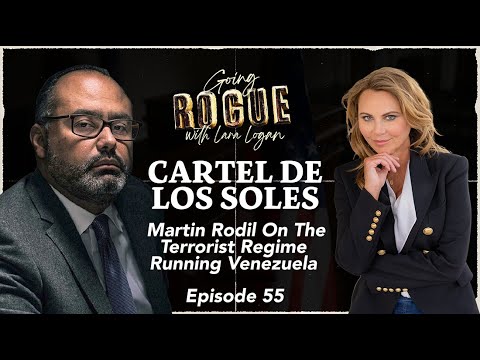
Lara Logan: Welcome back to this week’s episode of Going Rogue with Laura Logan. Our guest this week is right at the heart of everything that’s been happening in Venezuela with Nicolas Maduro, Cartel de los Soles and beyond. His name is Martín Rodil, but before we get to that, a word from our sponsor.
(Commercial break)
Lara Logan: Martín Rodil is a name that most Americans are not familiar with, but it is one that you are definitely not going to forget, after you hear what he knows and what he’s been doing for the past, basically for all of his life, for the past some 21 years, since 2005, investigating transnational corruption, national security issues, and intelligence matters.
But what makes Martín the man of the moment, this moment, in Venezuela is his work working with US agencies to investigate Cartel de los Soles, which is the main cartel in Venezuela, and of course, Nicolás Maduro. Martín has spent the better part of the last 10 years working on the indictment for Maduro and working with multiple US agencies, but primarily with the DEA Special Operations Division.
Martín, thank you so much for making time with us. I know there’s a lot at stake right now. You’re rushing from one thing to the next, but it is very important.
Americans, you know, our media has betrayed us for so long. The country was so focused on bringing down Donald Trump and fake news stories about Russia collusion that never happened and an insurrection that was really a setup to cover a stolen election and all of that, and people don’t understand how many of these things directly relate to the work that you’ve been doing investigating transnational criminal organizations, cartels, now terrorist organizations under US law, and how all of these things come together.
And then for a lot of people, you know, the indictment of Nicolás Maduro and, of course, the recent action came as a real surprise, because Maduro has been indicted for years, but nobody ever acted upon that until now. So, it would be a great place to start would just be understanding what your role has been in the Nicolás Maduro indictments.
Martín Rodil: Laura, I’ve been working, I mentioned to you earlier, since 2005 on doing investigations that were related only to the Venezuelan regime who later become known as Cartel de los Soles. So for the last 21 years of my life, I’ve been putting all my effort on investigating – actually, I started my career investigating the presence of the Iranian regime in Venezuela. So that’s how I started all this work. I was focusing on what was the nature of the relationship that Iran has with Venezuelan and the financial world.
So after that, we started investigating the next things that were connected to Iran, which was Hezbollah and the connectivity of Hezbollah into the drug trade coming out of Colombia via Venezuela.
And then after that, the person of Hamas, and after that, then the drug trafficking that ended coming into United States.
So that’s how one thing was taken to another, to the next, to the next and then around 2008, I started working with DEA SOD [Special Operations Division] out of Chantilly, Virginia. So I got recruited by them when I was briefing the US Congress on the Iranian Hezbollah threat in Latin America. And they came to that office, to that conference, and they saw my presentation and at the end of that, they asked me if I can have a meeting with them. And then, they invited me to join their work. So that was around 2008.
And there was a program named Cassandra, which was actually tracking the Hezbollah connection in Latin America with drug cartels, Mexico, Colombia, and other parts of the continent. So that was how we started that.
Then, Cassandra project got canceled by the Obama administration for no reason, in the middle of the best moment of that project.
And, and the only thing that was left was the Venezuelan investigation. So the bilateral unit of SOD, Special Operation Division, decided to focus on this. So, there was one prosecutor from Southern District, New York, his name is well-known now, Emil Bove. Emil Bove, later on, after he left DOJ, became President’s lawyer in New York on the case that President, one of the cases that New York threw on the President of the United States, and he become his lawyer. Then, he became the number three in DOJ in the second Trump administration.
And now he’s a federal judge in DC. So Emil was the person who actually indicted Nicolás Maduro, was the person who built the indictment. And Emil was working with SOD. And the agent, the principal agent on SOD was Sandalio González, who retired from DA, and now is a person that I’m sure you will like to have him in your program, sometime soon, because he has a unique insight of the legal process. He was on the other side of the table. I was in the outside, he was in the inside.
And I was bringing the witnesses. So my work, my role was primarily focused on recruiting potential witnesses. So we conduct more than 500 interviews over all those years and out of those 500 interviews, we recruit hundreds of witnesses. And they were not only for Nicolás Maduro. Nicolás Maduro actually came late, came a few years later.
Their real target was Hugo Chávez, who was Nicolás Maduro’s predecessor. And all the focus was on what Chávez was building. So we can talk, if you want, about the genesis of Cartel de los Soles.
Lara Logan: Yes.
(Commercial break)
Lara Logan: That would be very helpful, if you could explain exactly what is Cartel de los Sol, I mean Cartel of the Suns, and what you know about them.
Martín Rodil: I will describe Cartel de los Soles as a very unique cartel, because most of the cartels, if not all of the cartels that you have in the world, and the drug trafficking business, are criminal organizations that start on the street. I mean, a few guys got together, decided to start moving drugs, and et cetera, et cetera, and then, ended up being a big cartel, like Cartel de Sinaloa, Chapo Guzman, or Medellín Cartel with Pablo Escobar in the ’80s and the ’90s.
Cartel de los Soles was created for political motivation. And how do we know that? Because when we start recruiting members of the regime, and there was one in particular member of the regime that was very, very important in this investigation. That person was the person that used to be Chávez’s body man.
Not the bodyguard, the body man, the person who was the shadow of Hugo Chávez for 13 years. And I will be careful with revealing names of specific people, of witnesses, for reasons that you and your audience will understand.
Lara Logan: Yeah, because their lives would be at risk, right? They’ll be killed.
Martín Rodil: Yes, and all their family. As long as the Cartel is still in control in Venezuela, we have to be incredibly careful. One day, I will come back here and name those heroes, those anonymous heroes that actually helped the US Government to understand the nature of this of this criminal enterprise.
So this person, in particular was the first one who came to us, sat with us, and said, “Listen, this enterprise, this criminal enterprise was created under the orders of Cuba back in 2004. Cuba, Fidel Castro went to meet with Hugo Chávez and said, “We have the need to help the FARC in Colombia to fight the United States.”
So, the United States was helping the Colombian government under President Álvaro Uribe Vélez, a very strong conservative, decent man, to fight the FARC. And in fact, he defeated, militarily the FARC.
Lara Logan: And by the “FARC”, you are talking about the guerrillas in Colombia.
Martín Rodil: The Communist guerrillas in Colombia. They go back to the ’60s when the Soviet Union with Cuba were funding all those movements through Latin America, in Honduras, in Salvador, in Guatemala, in Venezuela, in Colombia and other countries. So –
Lara Logan: Yeah, and the US, through Seventh Group Special Forces and other programs; worked very closely with Southcom, worked very closely with the Colombian government under Uribe and really professionalized the forces. I mean, Colombia was Plan Colombia they used, right? It was transformed. The FARC came under enormous pressure. And then, the Colombian government ran a series of campaigns, encouraging FARC guerrillas to come out of the jungles. And really the FARC were in a lot of trouble. Their power had been pretty much decimated.
Martín Rodil: Correct. So, the FARC, actually the Colombian guerrillas were only guerrillas from the ’60s and the Soviet Union era, that survived after the Soviet Union. And the reason for that is because of the drug business. When the Soviet Union disappeared, they remained in control of the cocaine production.
But what the Cubans did – because the biggest narcos of the Western Hemisphere are the Cubans. They’ve always been involved, since Pablo Escobar in the drug trade, but they always do it in a way that they wash their hands and left others to get the blame and then, always get away with this.
So, when this person came to us and he was the body man for Hugo Chávez, he said, “I was in the meeting with Fidel, came to Caracas and instructed Hugo Chávez, ‘You need to do this, because we need to defeat the Americans in Colombia. And the only way…we can accomplish this is if we make the FARC financially stronger and if we do that, we need to help them to move the drugs through Venezuela.'”
Venezuela and Colombia share probably 3,000 miles of border, unprotected border, and the drugs flow in and out. But until then, Venezuela was a petro state, not a narco state, because we produce oil. So, so when that happens, Hugo Chávez gave instructions to his former head of military intelligence, Hugo Carvajal Barrios, who is now in a federal prison in the United States. Extradited years ago.
Lara Logan: Southern District of New York, correct?
Martín Rodil: He’s in the same prison as Nicolás Maduro today.
So he instructed his head of military intelligence to assist the [Venezuelan] government to help the FARC. And when this occurred, the FARC start moving drugs through Venezuela with the help of the military. That’s how Cartel de los Soles was born.
Why? Because the military started realizing how lucrative, how profitable was this business, how much money you can make. And instead of letting the narcos, the original narcos from Colombia to keep control of the business, they start becoming the distribution hub of cocaine of the world.
So they start taking cocaine from Colombia, but at the same time, they start taking cocaine from Bolivia too, where you have a very, and there’s – what is interesting, when you look into every major producer of cocaine in South America, all of them are Communists.
Evo Morales in Bolivia, he’s a Communist. Who took over Colombia [Gustavo Petro] and Rafael Correa in Ecuador. He’s a Communist, who was hosting all the production in the forests of Ecuador. In Peru, was less than Colombia, than Ecuador and Bolivia, but also was a Leftist movement, that was hosting the production of cocaine. So, this all goes along; it’s a marriage between criminal enterprise and ideology, Leftist ideology.
And one ultimate goal was to “Poison the streets of the United States, poison the American kids. So you will help the FARC to fight the United States Army, the Seventh Group, helping Colombia to fight with them and the same time, we’re going to make sure we flood Mexico with cocaine, so the Mexican cartels can distribute it inside the United States and we can never defeat the United States by a conventional warfare, but we can do a hybrid warfare.” And the hybrid warfare was “Let’s bring cocaine.”
Years later, fentanyl became the other drug of attack against the US and we can talk about that later on, but that’s how Cartel de los Soles was born, around 2005. So around 2005, the Army of Venezuela and the name “Cartel de los Soles” come because the generals in Venezuela do not have a stars. They have suns.
Lara Logan: On their uniforms.
Martín Rodil: On their uniforms. So there’s Three-Sun Generals or Four-Sun Generals, who are the ones who were controlling. Why is the Cartel de los Soles is different? Because it’s not run by Chapo Guzman or Pablo Escobar, who was just a street criminal, who become a very powerful criminal.
It was controlled by generals coming out of the Venezuelan Military Academy.
Lara Logan: So, very well-educated.
Martín Rodil: Hugo Chávez corrupted them. And then, they’ve [become] very powerful, financially. So that’s how this happens.
So, Cartel de los Soles is not like one very-defined structure, with a boss and a lieutenant and, you know, a pyramid structure. It’s a corporation of mini cartels. So, each general was building their own network and geographical space inside Venezuela.
For the American people to understand, the size of Venezuela is roughly the combination of California and Texas together.
Lara Logan: Germany and France as well, right? It’s another comparison.
Martín Rodil: Yes. It’s a very key geographical place.
Venezuela is part of the Caribbean because 3,000 miles of Caribbean coast. So, it’s part of South America, because you have the Amazonian [rainforest] that Venezuela shares with Brazil and is part, also of the Andean regio,n because you have the Andean mountain system. So is in a place of a crossroad of of geographical activities; close to the Panama Canal, close to the Caribbean islands; that goes from Trinidad, Tobago to Bahamas.
So you have access to the Central American corridor. It has access to the Caribbean corridor that bring drugs to the United States, via Bahamas or via Mexico and at the same time, it has access to the Atlantic [Ocean], directly, straight to Europe, so that they were shipping also drugs to Spain and to the Netherlands.
So now, when they realize how profitable, how effective was this tool to fight the US, then they start expanding. And then, think about this: This happened at the moment the United States was invading Iraq and Afghanistan, fighting terrorism in the Middle East. The oil price was $140, $150 per barrel. So Venezuela were being flooded with cash from oil sales, but also from cocaine. So this mafia start accumulating a wealth that no other mafia in the world ever existed have seen.
So in my work, also I’ve been working with the US Treasury Department and with the OFAC and trying to go after the money of those criminals. So there is one person which I do really have a greatest respect myself, which I’ve been working with for many years. His name is Marshall Billingslea.
Marshall was the Assistant Secretary of Treasury for Financial Crimes and Terrorism. So he was a person in charge of Treasury during the first Trump administration under Mnuchin, for creating the sanction programs against different countries; Iran, Cuba, Venezuela, all those countries that are enemies of the United States.
So working with him, I was not just focused on the kilos, but I was focused on the money. I was able to understand the crime from two different perspectives. OK, the kilos is the logistical part of this; how you move it, how you do that.
But then the weaponization of the money that was being produced by oil and cocaine to corrupt governments around the world. They put allies on certain places who will facilitate for them the logistics of the cocaine and the attack against the United States.
Lara Logan: So how much money are we talking?
Martín Rodil: The low ceiling, the most conservative estimate done by the Treasury Department and I’ve been discussing this with Marshall since [1999], February [1999], that Hugo Chavez took over Venezuela to November 2025, so a few months ago, in 26 years, the amount of money they have accumulated on three commodities; oil and gas, gold, because Venezuelans also have incredibly big gold mines, controlled today by Tren de Aragua. And the third commodity is cocaine, is at least $2.7 trillion.
Laura, I ask you and I would ask anyone in your audience, what other criminal organization in the world has accumulated such numbers, such a great level of wealth?
Lara Logan: $2.7 trillion
Martín Rodil: Trillion dollars, in 26 years. And that is actually a conservative estimate.
Lara Logan: Yeah, that’s what you know about.
Martín Rodil: Yes, this is calculating at very low level price of the barrel of oil and the kilo of cocaine and the gold kilos. I mean, it could go probably to $3.5 trillion. It depends, because it’s hard to establish an exact number, when you don’t have access to every piece of data that you need access to.
So, we’re talking about a massive criminal enterprise that exploded over the years of President Obama’s administration. It was under their watch. So, what is the problem during that time? We, at the DA keep doing this work and the administration was not supportive.
It was Emil Bove in New York who said, “I don’t care. Those are criminal. I’m going to keep doing it.”
Lara Logan: Who said that?
Martín Rodil: Former prosecutor, Emil Bove.
Lara Logan: Emil Bove was the one who said that. I see.
Martín Rodil: He’s the one who made the decision that, “No, I’m going after this. I don’t care. They are attacking us with drugs and we’re going to go after this, because the Obama administration was not putting any resources in to the law enforcement to do this.”
But at the same time, the Obama administration has a foreign policy that was very, very good for the Cartel de los Soles. And I will tell you, three of the foreign policies that was helping Cartel de los Soles: Number one, that we’re using people in the Cartel de los Soles to help the Obama administration reconciliation with Cuba (!)
Remember the trip of President Obama to Havana? That was organized by them. The second thing from that administration was the peace process in Colombia with the FARC, with President Juan Manuel Santos, the substitute of Álvaro Uribe Velez, who resulted in a Socialist (Gustavo Petro) and he was the one who pushed the reconciliation with the FARC.
And the Obama administration was sponsoring that. But what actually produced that peace process? Well, that the US Treasury lifted the sanction on FARC, removed them from the terrorist list and allowed the FARC access to billions of dollars that were frozen, that they used to fund the current Communist president of Colombia, Gustavo Petro.
Lara Logan: That’s amazing.
Martín Rodil: And the third element of that of that foreign policy of President Obama –
Lara Logan: Was the Iran nuclear deal –
Martín Rodil: Was the Iran nuclear deal, where Venezuela was a centerpiece of that. You’re right, because we’re going to have a very close relationship with the Ayatollahs. So, when we were trying to put those people in jail, the very same government who was supposed to support the DEA and DOJ [Colombia] was actually colluding or eating at the same table with all those criminals!
Lara Logan: It’s unbelievable. So, I mean, three nations that are essentially enemies of the United States; I mean, the Cubans, the Colombians, not, of course all –
Martín Rodil: The Leftists.
Lara Logan: Yeah, under the Leftists and then, of course, the Iranians; three nations that were were directly opposed to the interests of the United States. The Obama administration was sitting at the table with them, which is, you know, how you begin to understand why would you agree to a deal like the Iran nuclear deal, which was such a bad deal for America and for the world.
Martín Rodil: But not only that, it lifted the sanctions on some elements of the Iranian government. It let Hezbollah to roam free through Latin America. The Venezuelan regime were providing passports to the members of Hamas, Hezbollah and the IRGC. They were colluding. Those Iranians were flying to Mexico and coming to meet with the Mexican cartels.
I mean, they were crossing the border into the United States. I mean, using Venezuelan passports. We were watching all of that!
Lara Logan: Wow.
Martín Rodil: We couldn’t do much. And I was the only a private citizen. And the most of the rest of the people were government officials who have, as you know, limitation to this degree without consequences on their career.
Lara Logan: And you’re talking about American government officials, right?
Martín Rodil: Yes. I mean, the law enforcement people I work with, which I mean, I cannot tell you the admiration I have for them. I mean, it was the honor of my life working with those guys who risked their life to go out to chase those guys all over the world and trying to recruit the witnesses and bring you there when the very own government that was supposed to provide cover and help and assistance were at the table with those very same criminals.
Lara Logan: Was in bed with them.
Martín Rodil: Yeah, in bed with them.
Lara Logan: And by lifting, I mean, I think people understand, but lifting those sanctions against members of the FARC, the Colombian rebel movement, lifting the sanctions against members of Hezbollah and the Iranian regime. I mean, that’s kind of that’s dramatic, right? I mean, that changes. That’s your ability to move, to recruit, to finance, you know, to operate worldwide. I mean, these are not small things that were happening as a result of the Obama administration’s negotiations.
Now, you could argue, of course, that every government has to compromise. And, you know, if you’re if you’re if peace and, you know, preventing Iran from getting a nuclear weapon is your goal and, you know, and so on, if those are your things, those are your goals, that there’s some kind of diplomatic compromise that has to happen. But this seems to go far beyond that. Am I right in saying that?
Martín Rodil: Absolutely true. It was beyond that, because one thing is you made to you have to make concessions. Every government will make concession here and there and trying to. But another thing is basically to turn your head to into other direction and let those criminals to come and kill your own people. Because that, at the end of the day what they were doing when they are poisoning the United States in a way that we’re doing it.
I mean, how many generations in this country have been destroyed by these criminal activities; by the drugs? How many families in this country have lost their kids to overdoses or to the criminality that has been increased, because of these trafficking activities in the US? And the public health crisis that has created in the United States and the cost for for us, the Taxpayer, trying to cope with all of this? It’s just a disaster that was orchestrated by people who were supposed to prevent it.
Lara Logan: It’s so interesting, because if we go back to that time, Martín, this is the same time, the same administration under Obama that’s going out every day saying “We have an opioid crisis. We have to hold the drug companies responsible, because they have proliferated opioids.” And you know, we have this epidemic of opioids.
And so they cared about the opioids in theory, right? But they didn’t care about the drugs. And, you know, a lot of people will say, “Well, the thing with the drugs is it’s not the same as a war, because people are choosing to do drugs” and the old kind of defense, here is always that, “Well, if the appetite wasn’t there, if Americans didn’t want drugs, then there would be no market and then none of this would happen.” And so basically they blame the victim.
Martín Rodil: Right.
Lara Logan: “It’s Americans’ fault because Americans like drugs and they like to party and they don’t have their lives together. They become addicts and it’s on them. We don’t have to feel sorry about them. We don’t have to feel responsible for them, because they made personal choices and they’re responsible and accountable for their personal choices.”
But that is that is what is exploited in drug warfare. That’s what the cartels and the politicians know, because they know that people who are addicts are not joining the military, because they can’t pass a piss test. Then, they don’t have a sporting or athletic career for the same reasons. They’re not going into Congress because they can’t even hold down a job, let alone keep a family together. So the the ancillary costs are basically never-ending.
And the only reason we have any kind of idea about it is is that, you know, some studies have been done, I think, when there were around 60,000 overdoses back under the Obama administration, there was a study that said it cost the US economy over $525 billion dollars, if I remember that correctly.
But, you know, there’s not a lot of studies done that show the cost of it. So there’s a physical cost to your families. There is an actual, financial cost. And then, there’s a cost, in terms of the health of your society. And what people don’t understand is that with drug warfare, where you’re being targeted, it’s not the same as some, you know, washed-up addict, dying on the streets of Vegas. We’re now talking about people’s children.
I interviewed a DEA senior DEA officer 10 years ago who told me, “My agents prepared for war with the cartels. And what they’re doing now is going into people’s bedrooms and picking up 12, 13, 14, 15 year old kids.”
Martín Rodil: Listen, one thing that that I want to highlight on this problem is the ecosystem, the financial ecosystem created around this business and how that penetrates the political circles and the banking sector and other sectors in our society and how the lobby industry, they don’t openly lobby for a Cartel de los Soles, but there are elements of the lobby ecosystem who lobby for specific policies that actually help the business of drug trade. And that goes straight to politicians.
And that was no, I’m not talking just in the US I’m talking in Mexico and talking in Central America. I mean, the Cartel de los Soles has become cancer, because they were weaponizing the oil and drug money to penetrate every political or every government they could penetrate in the region, because they need friendly governments.
For example, in the Caribbean, how much is a cost of a political campaign of the Prime Minister of Martinique or Barbados? $30 million.
That’s one boat that we are seeing on the news being blown up. That’s it. That’s what it costs from one candidate that will play the game with you and you keep it in power or his party for the next 20 years.
And you have the logistical hub, so you can keep moving this. Same thing in Honduras, which you saw President Trump recently held endorsing and under-impressing. Who was the person sitting there? The wife of Manuel Zelaya, a guy who was involved in the drug trade with the Cartel de los Soles.
Because you need Honduras as a logistical place to move the drug plane from Venezuela to Honduras or to transfer to Mexico. And for Mexico, the same thing that were penetrating politics – but also, in the United States.
Lara Logan: That’s the part that people don’t realize: How deeply penetrated is the United States in that?
Martín Rodil: In the United States, it’s way more sophisticated. It’s not like drug trafficking lord comes here with a bag of money and gives it to someone. They were using very sophisticated – by the way, directed by the Cuban government, who understand Washington better than any other government in the world, because they’ve been watching Washington for 70 years and then they were basically helping the Cartel de los Soles to use CITGO, who is controlled by Cartel de los Soles.
Lara Logan: And explain who CITGO is.
Martín Rodil: CITGO, the oil company in the US. The gas station that you find in every town in this country, CITGO is owned by PDVSA. And PDVSA was under control of Cartel de los Soles.
Lara Logan: And PDVSA is the oil company of Venezuela.
Martín Rodil: So just to have understanding of the size of CITGO. CITGO has at least four refineries in the US, in Texas, Louisiana, and I think Chicago has another one. But CITGO in 2005 used to have more point-of-sales in the United States than McDonald’s. So this is how big this company was.
And this company became weaponized by the Venezuelan regime to fund political campaigns. And you can – that’s public data. You can go on who they were funding: the Democrats. They weren’t funding any conservatives. And they were using that as a tool. And this was happening at the very same time law enforcement is trying to stop it.
And one of the narratives that you have here, in the US is, “We will never win the war with the drugs.” So then, “We just need to legalize the drugs.” And I invite the American people to start looking for every politician who has been promoting that kind of narrative, who they took donations from and you will find interesting coincidences.
So no, it’s the same thing. “We will never be able to stop illegal immigration.” Look at the border right now. No one’s crossing the border. Yes, you can do it.
We also can stop drugs coming into this country. What we need is in a strong government, like President Trump is doing right now. And basically enforce the United States law, that’s all that you need to do. Enforce the law and go after them.
So I celebrate the action, the bold action taken by this administration to remove the head of the Cartel from power in Venezuela and start the process of dismantling. It will take a while, because you don’t dismantle such a level of criminality in three days.
But it would be a successful project. And I’m very happy for the American people, that such an enemy, that most of the time went under the radar. The Americans did not understand who or what Venezuela was, in terms of a threat, because it was a friendly government for many years until the Communists took over.
Lara Logan: And Martín, can you explain, it’s not just about drugs and and oil money, right, in the corruption of politicians. It’s also about elections.
Martín Rodil: Yeah, well, that will be my next topic, because the Cartel has become very sophisticated. That’s why I want to touch the financial part, because when you look into the financial side of this, then you understand how much money they have to fund election machines. It was an unlimited amount of resources. The cartel was sitting on $2.7 trillion.
How much it cost Dominion? How much it cost Smartmatic? How much it cost any of those company? For the regime, nothing.
Lara Logan: Nothing for them to buy them.
Martín Rodil: Nothing to buy it. And they need those kind of tools because they need to buy legitimacy under “democracy”.
So the cartels were not only poisoning the United States people, they were hijacking the election process, the democracy.
Lara Logan: Including the 2020 election.
Martín Rodil: Absolutely.
Lara Logan: Which was stolen.
Martín Rodil: It was stolen, absolutely. And it was funded by those criminals. And at the end of the day, people in America will start wondering, how these, and excuse my expression but I will use it, because it’s very graphic, a “Banana Republic”. How did a Banana Republic become such a threat to us?
Well, first of all, it was an oil republic, not a banana republic. So, it has a certain level of sophistication, because it built – the American oil industry built an incredible Venezuelan oil industry. And there were people in the country who were very well-educated. It was the most wealthy country in Latin America for many years. And they have resources and knowledge.
But then they come to realization, “Oh, we can build an election company. And then pretend that we are the democracy when we can control the result on our wish.”
Lara Logan: And that was back in 2004, correct?
Martín Rodil: That was back in 2002.
Lara Logan: 2004 was the Recall Referendum. The referendum, when Hugo Chavez was facing a referendum that he was going to lose.
Martín Rodil: Yes. So then they realized how good and effective was this, because how many people in the world, particularly 25 years ago, understand the complexity of software coding? Nobody. So you just trust, because you trust in general technology, because it’s helping you.
So you tend to trust. And they use that in their advantage to basically create a software that was embedded with all sorts of problems. And the way we learned about this is because when we were investigating the drug-trafficking and we started recruiting Venezuelan government officials that were part of the Cartel, they started saying to us, “Oh, we control elections. We also get people elected in Argentina, in Ecuador, in Bolivia, in Nicaragua, with election machines that we own.”
And then, they said, “Also, in the United States.” And we said, “Wait a minute, what? To control election?”
“Yeah, well, we own this.” And then when they started explaining. And at the beginning, we were – DEA has one mission: “Focus on the kilos”, right?
You can tell the DEA, “Hey, they’re smuggling a nuclear bomb.” And if you don’t tell them the nuclear bomb has a kilo of cocaine on top, they will not listen to you, because they need to stay in their lane, right?
Because they’re trying to do their mission, right? Other agencies are in charge of that other stuff. And they just rely on that. But then, imagine if I go to the DEA and say, “Hey, that general that was moving cocaine also controls the election machines.”
They will look at me like I was like an industry jacket. “What are you talking about?” And, “You’re crazy.” And it took us a very long process of education to actually convince certain people around us, “Hey, you know what, there’s a bigger problem than the cocaine, itself,” which is about this sophisticated criminal entity.
But who was behind that criminal entity? Cuba, China, Russia, and Iran. So every enemy of the United States will start realizing that the Regime acquired a company in Colorado named Sequoia, who was, at the time, owner of the 20% of the election market of the United States. And they installed their own software, the Venezuelan narco software in that company.
So, for many years in the US, the American people have been voting on software built by a cartel of drugs.
Lara Logan: It’s unbelievable. And what people don’t realize is that it’s the same software. So whether you’re talking about the election companies, whether it’s Dominion or it’s Hart InterCivic or it’s ES&S, whatever the companies are, Sequoia, they all use the same software.
Martín Rodil: The same. I mean, there are variations among themselves, but the elements are still there. So and in my case, I’ve been investigating the Dominion one. We were private citizens doing an investigation that probably more of the people that we will ask to join us would say we were crazy, trying to to do the investigation.
But what I’m trying to tell you is that what we, at the beginning thought was a very tiny problem and then, a little bit bigger, then it become a massive and I will do an analogy. It was they become a supernova of criminality.
So a supernova, because there was human trafficking. That’s how we found out about TdA; how Tren de Aragua was was created by the Regime. Then, it was weaponized to go after the Venezuelan opposition. And they realized that army was so good at killing Venezuelans, so they don’t have to use the police.
And they said, “Oh, here’s a police state killing the poor people from the opposition.” They will use a criminal gang to kill Venezuelan political opponents and torture them. And then, it looks like, “Oh, street crime.”
Lara Logan: Yeah, “It’s just it’s just criminals.” It masks the political nature.
Martín Rodil: They moved that gang to Chile, which was a conservative government, to go after them and to Peru. And then they moved, again at the end, to United States. So so that’s why I call it the “Supernova of criminality”. People in the US just learned about Maduro, recently.
I mean, it’s because President Trump has been highlighting this, primarily. I mean, let’s remember that it was President Trump in the first administration who indicted Maduro.
So just to explain this important part to you, building an indictment of a head of state, it takes years of work. This is not something that was built overnight. It took us at least 12 years of investigative work, putting together the witnesses, putting together the evidence, recording and following the money, investigating financial records around the world. Swiss banks, UK banks, Chinese bank, Russian banks. It’s a massive amount of work.
And that’s how, in the first Trump administration under Attorney General Bill Barr, 18 members of Cartel de los Soles got indicted and they couldn’t be brought to justice at the time; that was in March 2020. Then, we know what happened on November 2020.
But what is interesting, for your audience is what happened after when President Biden took over the White House: A few months later, the most important member of Cartel de los Soles, who were in sitting in the US prison, including the nephews of Nicolás Maduro, that were captured by DEA in Haiti, trying to move a hundred kilos of cocaine into the US, got a presidential pardon from President Biden.
And a guy named Álex Saab, Colombian-Lebanese guy, with links to Hezbollah, who was involved in the drug-trafficking and weapons-trafficking and money-laundering, also got a presidential pardon, full pardon – probably, by the Autopen.
Lara Logan: Wow. So, it’s Álex Saab, Maduro’s nephews, whose names do you remember them?
Martín Rodil: Yes. I mean, off the name on the top of my head, I don’t remember the names, but I can send you, later their names. You can Google it and you will find full presidential pardon with no explanation.
Lara Logan: And of course, the media has no curiosity about any of these things.
Martín Rodil: Although the Biden administration decided to lift sanctions on PDVSA,
Lara Logan: Which is the Venezuelan oil company that at the time.
Martín Rodil: Oil company. So it let the regime to regain strength, financial strength and the Venezuelan team inside DEA got reduced to two persons.
Lara Logan: Wow. That’s the other thing that they do that nobody notices. They quietly, you know, send people home through controlling the money and the personnel. That’s how they cripple these initiatives.
Martín Rodil: Like, you know, President Trump set up this working group to investigate Weaponization of the Government and they’re not getting any people and they’re not getting any money. It’s all being blocked by someone who’s, you know, probably very uninteresting to the American public, because they’ve never heard of them. And this is a person who’s in charge of personnel at the DOJ. That doesn’t sound very exciting, does it?
Martín Rodil: Yeah, absolutely true.
Lara Logan: And look what they’re able to do.
Martín Rodil: So now, too, because a lot of information to be consumed, everything we’re trying to address, today and to basically zoom-out, a little bit:
So, we have a nation-state converted into a criminal organization, that went from being a petro-state into a narco-state, who allied to every enemy of the United States in the world and has been waging hybrid warfare against the United States.
Lara Logan: With diplomatic immunity.
Martín Rodil: With diplomatic immunity and with incredible penetration of the US financial system, because they own CITGO inside the US. So, they have access to the financial system. They have access to the business community. They have a legitimate business installed in the country.
So that mix of oil and cocaine was crazy stuff that is unacceptable that the US National Security apparatus did not confront it. And it’s only being confronted by President Donald J. Trump. God bless him.
Lara Logan: What’s the role of the Chinese in all of this?
Martín Rodil: Oh, the Chinese are the worst of all the [Venezuela] supporters. Almost as bad as the Cubans, because the Chinese are very sophisticated, in pretending they are not involved. But they are the ones who were actually managing and controlling Maduro.
Lara Logan: Interesting.
Martín Rodil: So, the Chinese were behind it. This is Chinese warfare against the US, using a proxy. They realize this country [Venezuela] has become rock. No one is looking at them. No one is paying attention to them.
And they quietly, move into Venezuela and start doing – like Smartmatic voting machines. In our investigation, we found out there were not made in Taiwan. They were actually made in China. And they shipped them to Taiwan from Beijing. And they relabeled them as “Made in Taiwan”, so they can enter the US market.
Lara Logan: So that’s Chinese spyware on it, by the way?
Martín Rodil: A hundred percent. I mean, that’s why the US Federal Government has prohibitions for agencies like the FBI, CIA, DEA to buy any equipment that come electronic equipment, like photocopying machines or that kind of thing. So routers that come from China, because all the Chinese, at the very littlest opportunity they have, to infect any of those devices, they will do it. Yet, they were choosing who sat on 1600 Pennsylvania Avenue. With Chinese hardware and Venezuelan software!
Lara Logan: So what kind of power does that give Cartel de los Soles, if they’re instrumental in installing a president in the United States of America, the most powerful country on Earth?
Martín Rodil: Well, imagine, I mean, they can hardly believe it, themselves, how successful they’ve been on this endeavor and how incredibly effective they have been become!
Lara Logan: But Martín, you know, as you’re saying that, I realize what the difference is. There’s one element of this that we haven’t described, isn’t it? And that is it’s not just that the Cartel is allied with the Iranians and and the Cubans and the Chinese and America’s enemies. It’s that the Cartel has allies within the United States. That’s what really gives it its power.
Martín Rodil: But they can blackmail, either because the money they provide or the political help they give with the machine. So that’s a problem. You create kompromat.
Lara Logan: Or they share the same goals of ideology. If you have Communists and Marxists in the United States in positions of power and they share the same goals, or you have Globalists who seek to destroy borders, destroy nations. Now, is where your real power comes.
Martín Rodil: Yes. So for me, it has been a very difficult process, because I was born in a country that got destroyed by Communism. And then I moved to this amazing, beautiful nation who has adopted me. And my kids were born here. So my kids are Americans.
Lara Logan: And you’re about to become an American Citizen.
Martín Rodil: About to become a US Citizen. So proud to do that. And to join this incredible nation.
I mean, this is, for the nature of my work. I’ve been traveling all over the world. I have visited probably more than 70 countries and I always say this to my kids: “There is no close to match anything that the United States of America means. In their generosity, in the greatness, in the incredible creativity and innovation.”
But the saddest part of what I lived through, being in this country with all the beautiful things that this country has and found out (very few) Americans decide to betray their own country, to collude with those enemies. And that is very sad for me, because I was like, “You betrayed your mother. You cannot do that!”
Be grateful for what you have. I come from a country, where people lost everything. I lost my whole family. I couldn’t see my mom for 20 years, until she passed away. My sister passed away, with me on the phone, dying from cancer, because the Regime took away their passports. They couldn’t travel out of the country.
If I go there, I’m going to end up killed, the moment I put my foot there. So you cannot take anything for granted in life. You need to be appreciative of how fortunate you are to be born in a country like this.
And that’s why people I have been working with that’s in the law enforcement, I saw them giving their best to protect this nation. And it was the honor of my life to be working with them, to do my contribution to a country who have given me so much.
Lara Logan: So, for you personally, Martín, after so many years of working, more than a decade working on the indictment of Maduro and presumably his wife as well, I’m sure you worked on that too, what was it like for you to see the United States finally execute those indictments and bring Maduro and his wife into the US?
Martín Rodil: I have to tell you, that night when the operation was happening, I was about to go to sleep when I started getting messages from people on the ground, that “We have a there’s bombing here” and obviously, trying to make phone calls and trying to corroborate it.
And it took me a while to realize, until President Trump put out a post on True Social saying, “We have successfully captured Maduro and move him to US custody.” It was very, very important moment in my life, because, not “The whole thing is over,” but after 26 years of trying to protect this nation from those attacks, to see that the head of the snake was in custody, I felt so happy, not just for the work I did, but for the people in law enforcement who I worked with for many years and helped with at the DOJ. There were incredible people in the DOJ who prosecuted this, who did indictments and I know how much effort they have put into this. And I felt that the light at the end of the tunnel was coming.
Lara Logan: But Martín, can you explain to people, I mean, there were images all over the world of Venezuelans celebrating and in a way that’s kind of what you would expect to see. But what also happened, this time is that there were all kinds of videos of people recording the moments when they told somebody that they loved or someone in their family or friends, that Maduro had been indicted. And there were people who were weeping.
Now, of course, most of the media focused on the handful of paid protesters or the people that were ideologically or politically motivated and directed to be out on the streets, many of whom didn’t even know why they were there, when interviewed.
But the focus in the media was on trying to show the counter, the people who were against what happened. But they couldn’t stop this tide of footage, videos and photographs and commentary from all the Venezuelans all over the world.
I know some eight million have been forced out of Venezuela under Chávez and Maduro as they’ve impoverished the country. But can you explain what does it actually, practically, physically mean? Because, Maduro, not the sharpest guy, right? I mean, he was the face of the Cartel. He was in charge and he was directly responsible for what was happening but at the same time, not the evil mastermind, right?
Martín Rodil: They’re still there. Yes, they’re still there. I mean, they’re still controlling, but they’re in the way out. So I’m not…
Lara Logan: You mean like the Delcy Rodríguez’s and the Jorge Rodríguez?
Martín Rodil: I will tell you, Delcy Rodríguez thought President Trump invited her for a party on the roof of the room and she realized President Trump invited her for a funeral home. And she’s in charge of… She’s the funeral director and the funeral is for Cartel de los Soles. So I don’t think she’s as happy as many people think she is.
Lara Logan: I see.
Martín Rodil: Because the Trump administration knows exactly what has to be done. And that’s OK. I mean, you have to work with people. I mean, this is a regime change. The Venezuelan vote, overwhelming for Edmundo González and Maria Corina Machado.
They stole the election, because that’s the best practice in the regime. And at the end of the day, the Regime changed when the Venezuelan people were actually trying to exercise the right of democracy to vote and it was stolen from the Cartel and what the President Trump is doing is actually trying to bring democracy, not to Venezuela, but to the Western Hemisphere.
The Monroe Doctrine, or the Trumproe Doctrine.
Lara Logan: (Laughs) The Trumproe Doctrine! Based on the Monroe Doctrine, but trumped up.
Martín Rodil: Trumproe Doctrine that he’s doing. I mean, he took back into the hands of the United States security the Panama Canal at the very first action he took after he took the White House, telling the Chinese, “Get the Hell out of here”. He’s doing the same thing with Russia, with Iranians, with Hezbollah, with Hamas, with the drug cartels.
I mean, this is going to grow an incredible economic prosperity for those countries, where the US industry will benefit from. Not just the oil industry or energy industry, but many other industries.
Lara Logan: OK, but before we get to that, can you just explain what it means for Maduro to be gone? What does that mean to the people in Venezuela?
Martín Rodil: I mean, you can see some videos on social media. I mean, people crying, people joyful. Unfortunately, most of the videos you see is from people outside Venezuela, because as I said, the Cartel’s in place, the Venezuelans inside the country have to be very careful. If they’ve been caught celebrating, they get thrown in jail, they get tortured. But they, in their heart, they know the change is coming.
Lara Logan: But it’s just going to take a little while for them to start celebrating. But it’s going to take more than Maduro, correct? Because while Maduro is gone, the cartel is still in place.
Martín Rodil: I mean, just to let you know, Jorge Rodríguez, who is a president of the Venezuelan National Assembly, is the real owner of Smarmatic, the one behind the creation of Smarmatic, which is Delcy Rodríguez’s brother.
And the President calls Delcy Rodríguez the “Interim President” of Venezuela, which is correct. That’s right. She’s the interim. Until a new, better day comes, and then the rest of the Venezuelans will be able to celebrate.
But let me tell you, this is not only the Venezuelans who are celebrating. The Colombians are celebrating, the good Colombians, the Brazilians, all the population of Latin America who has suffered the consequence of this cancer spreading all over the region are grateful for the United States of America and for President Trump for doing this.
Lara Logan: Is there an indictment coming for Dulce Rodriguez?
Martín Rodil: (Smiles broadly) I would rather not talk about it. I will let the administration talk about that.
Lara Logan: Sure, I understand. But let’s just put it this way: The Maduro indictment is not the last.
Martín Rodil: Absolutely not. It’s the beginning of many.
Lara Logan: OK, and so if you can, if the United States actually succeeds in dismantling Cartel de los Soles, right, which is a, you know, it’s a huge undertaking. It’s fraught with risk. Some of it’s going to go wrong, inevitably, they’ll use that against Trump in the media. But nobody’s been willing to take it on. You’ve had this indictment that was there, through the Biden administration. They didn’t act on it. The Trump administration the first time didn’t act on it. It’s taken a long time to get to this point.
I just wonder, you know, what does the road ahead look like? Because the President is being, you know, you could say very deliberate here. It’s the way it appears, superficially from the outside, without having the inside knowledge. Because, you know, he moved all those, he moved all the warships in place. He moved all those resources, military resources in place. But he didn’t go, right? I mean, there were a lot of people wondering, “What on earth is happening? We’ve lost the element of surprise. The whole world knows that Trump is going to move on Venezuela.”
And then ultimately, you know, he just did that one night of strikes and there was no, well, certainly no follow-on operations that have been reported. There might be clandestine operations going on that I’m not, you know, the public isn’t aware of. But what else is going to happen here? Because I know that Gary Bentsen said there’s a council. I’m not going to go into details. Nobody wants to jeopardize the council, itself.
Delcy Rodriguez knows there’s a council. She’s not interested in working with them, according to reports. So what happens now?
Martín Rodil: Listen, I mean, I will be careful in telling you, I mean, in the military aspect, President was very clear to say I am not going to remove the forces from that place because he understands the job is not done.
The very important person in the President’s team is Marco Rubio because Marco Rubio, Secretary of State Marco Rubio, as a senator from Florida, has been very close to the Venezuelan-American community in South Florida. And he understands the true nature of every one of those criminals. He’s been working on this since he was in the Senate.
So, it is a blessing for the Venezuelan people to have Senator Rubio, now Secretary of State Rubio, as part of the principal member of the team, there in the Trump administration, in charge of this.
To be honest, I don’t know exactly what decisions are being made inside the White House or where their planning is, but it’s very clear that the plan is to get rid off of the Cartel. And it will not be a “Cartel Lite” after this. It will be a true democracy.
Lara Logan: Well, I understand that there are elements within the US, especially coming out of the CIA, who are pushing for Cartel-Lite. So, when I see Marco Rubio go out and say “Delcy Rodríguez is going to be the leader of Venezuela,” it’s like you’re thinking like, I mean, “Are you serious?”
Martín Rodil: Well, I will tell you, I get your point, but I also will tell you, Secretary Rubio saying that is the worst curse he can do to Delcy Rodriguez today.
Lara Logan: Because?
Martín Rodil: Because the cartel will kill her.
Lara Logan: She’s still breathing. She’s still breathing, Martín!
Martín Rodil: Well, that may change. I don’t know. But she will be lucky if she comes alive out of this. Because she’s a person with two knives. One knife is the Gerald Ford aircraft carrier, and the other knife is Cartel de los Soles.
If she pleases President Trump’s demand, the Cartel goes that way. If she pleases the Cartel, the Delta forces take care of the rest of the Cartel. So, I believe the strategy of the White House is the implosion of the Cartel.
Lara Logan: I see.
Martín Rodil: And then, to work very slowly with a long-term strategy to substitute, so the US does not get involved into nation-building or regime-change or using the American troops. I mean, it’s genius what he’s doing. It’s genius.
Lara Logan: Well, it is very interesting that you say that because, of course, when Trump goes there and says, “Oh, well, America is going to run Venezuela,” of course, that plays right into the hands of all the people who say, “Wait a minute, I thought we were done with regime change,” you know, and “How is this going to work?”
Because we saw it fail spectacularly in Iraq and Afghanistan in recent history. And so, you know, why would we think it’s going to fail here? And also, most Americans just don’t want to be involved in regime-change anywhere.
Martín Rodil: A hundred percent. But I will say just to the American people, what President Trump is doing is not regime change, because we want a friendly guy in the neighborhood, who’s going to be helping us on our whatever foreign policy we want to establish.
He’s actually attacking a country who is attacking us.
Lara Logan: That’s what people don’t understand.
Martín Rodil: Who is defending the US He’s defending a family from Iowa who their kids are struggling with drug addiction and that is ruining the family. The he’s protecting the unity of the family when he go after a group of criminals who principal objective is to poison the Americans kids.
Lara Logan: But look at the ideology. You talked about that ideological alignment with the drugs and the money and power, right? And these are people who don’t want the American family to be preserved. They’re at war with the American family. That’s part of the ideology, right? So you see the synergy, there. They push for the legalization of drugs. They push for the separation of children from their parents.
Suddenly, they don’t care about how many people are we talking about? How many children are trafficked by Cartel de los Soles?
Martín Rodil: I mean, millions. I’m talking hundreds of thousands, if not millions of people. Hundreds of thousands every year.
Lara Logan: Every year. Yeah, so millions.
Martín Rodil: So let me put it this way. I mean, 9/11 was a horrible tragedy in the United States. We lost 3,000 people that day and many more, as a consequence of the aftermath of 9/11. Cartel de los Soles have killed that amount of people in three months in the United States, poisoning American kids.
I mean, the amount of people that get killed by drug overdoses every day. And one important thing is the narrative on mainstream media is like, “Well, those both have cocaine. It doesn’t have to do with fentanyl.”
Well, Cartel de las Soles also take the chemical from China that are the precursors of the fentanyl that is made in Mexico. So they not only ship cocaine to Mexico, they also ship chemicals that are brought from China, via Venezuela to Mexico.
Lara Logan: And the pill presses, right? The dyes, all the things that make a Percocet that look, you know, when it’s a fentanyl pill, it make it look like it’s a Percocet or make it look like it’s a Xanax or, you know, whatever it happens to be, right? They’re providing all that infrastructure that builds the fentanyl industry.
Martín Rodil: Yes. So, and it helped with the money-laundering and it helped with other things. So it’s part of an ecosystem. It’s not just like Venezuela moves one kilo from point A to point B and that’s it. I mean, it’s an integral part of a big ecosystem of criminality that is targeting, day in, day out the United States of America.
Lara Logan: So Martín, describe for me, because I did an hour-long film about Venezuela years ago. And so, I began then to learn how many people had been disappeared, you know, under the Maduro’s illegitimate rule, under the Cartel, really. How many political prisoners there were, how many women were just taken and either raped, murdered, tortured, how many, how poor Venezuelans were.
You know, you remember the footage of Venezuelans going through the trash, looking for food. And we’re not talking about, you know, some homeless people on the street. We’re talking about people across the country.
I mean, when you drive 8 million people to flee for their lives, that is quite something. So can you give us a sense, as a Venezuelan, as someone who has family and friends and is in touch with people there, on the ground, can you give us a sense of what it has been like, living under a cartel?
Martín Rodil: Well, let me say this to you. Fortunately for me, I’ve been 26 years in this country. So, I left at the very beginning of the regime, like months into the Chávez’ first term. And I did not live, myself directly the struggle in the country because I was living here, in the U.S. But obviously the family I have there who slowly were disappearing, struggled with exactly the human terror, the human crisis that you are describing. They, I mean, when you think about the human cost of this is just unthinkable, is a horror movie.
I mean, the disappearance. I mean, I do not have on the top of my head the numbers, but I can tell you we’re talking about thousands, if not millions of people, who their life expectancy got shorter, because they destroyed the health system of the country, because people do not get medicines.
I remember, I’m going to tell you this story to make it more graphic, what is the human cost of this? I have a good friend of mine from a city in the Andean part of Venezuela called Merida. Beautiful place, by the way, in the middle of the mountains. It’s like the Venezuelan Alps, the Venezuelan Rocky Mountains. Very beautiful city. And one day, he called me concerned that his good friend, a priest from a neighbor church, had to go to a mental hospital to ask for help. And he was telling me the struggle of his friend, his priest, his pastor at his church.
And I asked, “Well, what’s going on with him?” He said, “Well, he happened to be the priest of a kid’s hospital,” like a hospital only for kids, nearby. And he goes all the time, always for the oncology part of the hospital where the kids with cancers are. And he is such in distress, because every time he goes and meet the kids, the kids ask him for a miracle to calm their pain from cancer, because it was the medicine painkiller for them.
So that is the nature of the tragedy, when you have eight year old kids dying from cancer, this regime is looting a country with trillions of dollars! And meantime, those innocent souls cannot have even one painkiller to calm…
So the priest couldn’t endure that any longer. And he had to look for professional help, because he was on such level of distress and pain, himself because the kids innocently were asking to the priest, “Help us with a miracle. You are closer to God.” This is what we’re dealing with.
Lara Logan: It’s unbelievable. And I’m wondering, that point at which Venezuela went from being a petro state to a narco state, really was with the rise of the Communists?
Martín Rodil: 100%.
Lara Logan: That would be Hugo Chavez’s legacy.
Martín Rodil: That would be Hugo Chavez’s legacy.
Lara Logan: Which happened when? What year was that?
Martín Rodil: 2000, 1999-2000. 1999. He banded in February 1999 and it took him a few months to start gaining control of every institution. So he started with the police, then with the military, then with the oil industry, then with Electoral Council, with the Supreme Court. And he was substituting. It was a slow-cooking process until he gained control of everything, around 2002-2003. He changed the law; the amount of Supreme Court judges were nine and then he increased it to 23.
Lara Logan: Wow, that sounds familiar. Nothing like what the Democrats are proposing to do in the United States!
Martín Rodil: It’s the same playbook. And then, he took over. He took over control of every institution and then, he destroyed the economy. Venezuela became the most efficient factory of poverty in the world, to the point that Venezuela produced more immigrants than Syria, which was in a civil war.
So eight million people. And by the way, it’s sad because 99% of the Venezuelan immigrants are good people. But Maduro has the great idea to ship Tren de Aragua into the United States. So the image the American people have of Venezuelan immigrants is like they’re gang members, because what Maduro did.
So, as part of the consequence of the tragedy is, you are being an immigrant, looking for help and the whole world looks at you like you are actually a criminal, because the very same regime who made you leave the country took the worst criminals of the country and start moving them to the very same country you were looking for refuge.
Lara Logan: Yes, and what people don’t understand, you know, when you say “gang member”, they don’t really understand that Tren de Aragua is not a gang. It’s a foreign paramilitary force that was infiltrated into the United States to create violence, to create instability and really, to act as an arm of America’s domestic enemies. Domestic and foreign enemies working together.
Martín Rodil: There are two letters recently being issued by two generals from Venezuelan army who are in custody serving sentencing prison time in the US who make a public letters explaining how Tren de Aragua was created by the Regime as a paramilitary force, in the form of a gang. So it looks like “crime street”. But it was…
Lara Logan: One of those Venezuelan military officers is Hugo Carvajal. Who you mentioned. And why is Hugo Carvajal in custody right now?
Martín Rodil: Well, he plead guilty on several charges of drug trafficking. And, I mean, he was part of the generals who grew up following the orders from Hugo Chávez to help the FARC and as well like Clíver Alcalá-Cordones. I mean, I don’t want to go in deep into the level of responsibility they have or not. Or follow the orders.
Lara Logan: Sure. I’m just trying to help people understand. So, you have these two very senior figures from Venezuela who are in US custody and as I understand it, Hugo Carvajal has been trying to share the information that he has with the Department of Justice. And people are not… Has he even been interviewed?
Martín Rodil: As far as I know, he has not been interviewed, yet. Now, probably he will be interviewed, because now, they have Nicolás Maduro in custody, so they may need his testimony.
But I will tell you that the problem is now he knows not only about the crimes of the drug-trafficking. He knew about the all sorts of crime that we have been discussing throughout this program. And then there are probably people in this country in the government side, different agencies that may not like him talking about things they’re better off if he’s shut up.
Lara Logan: So I’ll say it for you: The people inside the CIA and inside Congress who are dirty, who have a lot to hide, and Carvajal and Maduro know who they are, right?
Martín Rodil: They know who he is. They know exactly who they are.
Lara Logan: And these people now, I mean, they’d rather see Maduro and Carvajal dead, wouldn’t they?
Martín Rodil: Probably
Lara Logan: It certainly would benefit them.
Martín Rodil: Yeah, I mean, I assume that will be the case. But I can tell you one thing. What we can do is actually do the opposite of that, which is make, throw the light into his testimony and what he knows and make sure the American people understand the truth. I think the truth kills any other thing. I mean, I remember the propaganda machine saying those “conspiracy theories” about Smartmatic. “Smartmatic never have done election in the US.”
And I can go on and on and other things, I mean, like that. And I saw the other day someone with a T-shirt that said something like, “Every conspiracy theory that I’ve been accused of peddling happened to be now all true or all conspiracy – not theories – but conspiracy.
Lara Logan: Yeah, yeah.
Martín Rodil: So, that’s pretty much what is being exposed, here.
Lara Logan: They’re conspiracies, they’re not theories. Yeah, they’re actual real, seditious conspiracies.
Martín Rodil: Let me say this. You cannot go to a grand jury on drug trafficking charges and being charged, because you just want to indict someone. I mean, judges are very strict with that. So, the threshold of evidence and testimony and witness is really high.
So, anyone who come forward saying, “Oh, this is all done for the oil, political reasons.” Speaking about oil, the US won the Venezuelan oil. The US has paid for every drop of oil ever taken from Venezuela. The US is the only country in the world that has taken Venezuelan oil, paying for it.
Just to give you an example, Cuba for 26 years got from Venezuela 100k, 150k barrels of oil per day, per day, for free. Cuba did not go to Venezuela, looking for the “Recipe for the arepas“, neither the Chinese! They were there for the oil!
The oil industry in Venezuela was built by the American oil industry. Venezuela stopped being a rural country and became a very strong economy in the ’50s, ’60s, ’70s because the generosity of the American oil industry to provide the expertise to the locals how to build their own oil industry.
So when I hear people saying, “Oh, the American government just want to go for the oil,” let me tell you, I’m so happy to hear that! Because that’s the only people in the world who actually pay for the Venezuelan oil!
Lara Logan: And Venezuela has the largest natural oil reserves in the world, right?
Martín Rodil: In the world, 300 billion of barrels in proven reserve, which does not include shale oil. If you add shale, maybe you get to 400 billion.
So a lot of wealth that we’re talking in Venezuela, right now between oil and minerals and a couple of other assets Venezuelans have is being estimated by professionals in the field about $15 trillion.
Lara Logan: $15 trillion dollars?
Martín Rodil: $15 trillion dollars in wealth. And this was being managed by a drug cartel, Russian, China, Iran, and Cuba! Give me a break!
Lara Logan: And what is the level of poverty in Venezuela? How many people live below the poverty line?
Martín Rodil: Oh, above 90 percent. Above 90 percent.
Lara Logan: So one of the naturally richest countries in the world.
Martín Rodil: Yes.
Lara Logan: One of the highest poverty rates.
Martín Rodil: And let me say a little bit about history of Venezuela and the United States. This is data that very few people know: Venezuela provided to the United States most of the oil that was used in World War II. Venezuela was the only country where ships were sunk by the Nazi U-boat, the submarine from the Nazi, because they were trying to cut off the supply line between Maracaibo Lake and Corpus Christi, Texas. Venezuela was the most reliable supplier of energy to the United States in the ’70s, when the Middle East broke in wars, and the shutdown of the Suez Canal, and the Yom Kippur War, and all those conflicts , when the Arabs were blackmailing the rest of the world with their oil, Venezuela was pumping as much oil as they could to supply the United States economy.
So, Venezuela is the only country who played baseball in the world, that the Marines had never been there, brought it in. It was the oil industry. So the Venezuelan majority looks at the United States as the big brother, the role model that you want to emulate, that you want to be like.
And I heard one comment from a Venezuelan. Actually, he’s not a Venezuelan. He’s a Colombian, very well-known politician. He told me one day, and very sad, because he said, “We all, within Latin American wanted to be like the US,” and he said that during the Biden administration. He said, “And now, I found out that the US want to be like us, a disaster.”
Lara Logan: Fascinating. And let me ask you something, Martín, because this is not just about drug trafficking. I mean, when you talk about that relationship between, for example, Iran and Venezuela, does Iran have bases or logistical bases, logistical hubs, important territory, ability to operate inside Venezuela?
Martín Rodil: They, I mean, I can go on a map with you and I can point of all the location, the IRGC control, physical locations. The Iranian Revolutionary Guard Corps.
Lara Logan: The Iranian Revolutionary Guard Corps. Essentially the cartel that runs Iran.
Martín Rodil: Yes, yes, exactly. And they were partners, they’re being partners. And they control ports in Venezuela. They control their own logistical hub. They control weapon deposits. They control drone factories. They control uranium processing plants, because Venezuela has uranium, not the quantity like Canada or Russia or US, like you have mining in Montana of uranium but a decent amount of Iranian that the Iranians wanted for the nuclear program.
I mean, I can go on and on and on. I mean, Venezuela was always protected during the Cold War, because the US was trying to prevent the Soviet Union, which Cuba always looks at Venezuela as a place to grab, because of the oil wealth.
The Communists are like a parasite. They don’t produce anything. They know how to live off other people’s money. And that’s what they were looking for.
And the US was protecting. And that changed during the Clinton administration. When the Soviet Union collapsed, the Clinton administration decided to remove all the assets the CIA used to have there and the diplomacy and left Venezuela abandoned.
And then, the Cubans saw the opportunity to come and grab it and Venezuela was like a very naïve society, that did not understand, because it’d always lived under the umbrella and protection of the United States. Venezuela did not have intelligence service, because you rely always in the US. And at that moment, the US removed themselves from the equation, with the Clinton administration, they became an easy prey by the Communists of Cuba – and China, who was in the race – and look how this story ended. Look how it ended.
Lara Logan: And so, if you have that level of cooperation with Iran – people forget that the IRGC and Iran have been named as the Number One State Sponsor of terrorism worldwide for, you know, I mean, going on three decades.
Martín Rodil: The first time I went to the US Congress to talk about the Iranian presence in Venezuela, I ended up being mocked. And I remember elements of the intel community came forward, saying that I was working with Ambassador Roger Noriega, who was US Ambassador to the OAS, Organization of American State, and later on become Assistant Secretary of State for the Western Hemisphere during President Bush 43 and Colin Powell was the Secretary of State. So he and I were trying to educate the lawmakers about this.
And the intel community will come after the two of us. Ambassador Noriega is from Wichita, Kansas. And they said that we were crazy, that we were basically two nutheads going in the city, talking about nonsense.
And today, this morning, the Department of War announced the confiscation of a ship that was coming from Iran named “Bella One”. And it was trying to enter to Venezuela. And when the US Navy trying to board, they basically declared hostile and they changed the flags, they painted the Russian flags on the ship, and they trying to go to Russia.
And it was captured today between Iceland and the UK, by Navy SEALs. I just waiting to see what the Navy SEALs will find inside the ship. Why the ship was so afraid to be captured by the US? And that ship was coming from a port in Iran.
Lara Logan: That’s not oil that they’re protecting.
Martín Rodil: No, there was empty of oil. So there was something else inside. Because, if you don’t have anything to hide, “You want to come over the ship, come over the ship. There’s nothing.” If you run away and the US Navy and the US Coast Guard spends almost 12 days chasing the ship until finally, today got captured by the US Navy.
So, I mean, there are so many things that, obviously, we cannot go over in one interview because it’s years of work. But what I can tell you is, the world today and the United States, today and Venezuela today, is a much better place, thanks to the action, the bold actions of President Donald J. Trump, but more important, the Armed Forces of the United States.
Those Delta Force guys who went almost like a movie inside the country, without losing anybody. But risking their life with courage and tackled the biggest problem we have in the neighborhood, which was this criminal organization, is something like every American should be proud of.
Lara Logan: Well, what if it stops there, Martín? What if they don’t finish the job?
Martín Rodil: There are many Martíns out there, fighting for keep doing it, believe me. There are many Americans and people like me, who will keep the fight. And I don’t think President Trump sees this as the end of the process, but instead, as the beginning of the process.
Lara Logan: Now, isn’t it kind of dangerous for you to be speaking out publicly, given the nature of what you do? I suppose you’ve been doing it for so long at this point that there’s no hiding it. I mean, they’ve come after you. You’ve been attacked. You’ve been accused of being an Israeli spy. You’ve been accused of everything.
Martín Rodil: No, they even went worse. They used their money to put a Leftist government in Spain. They worked to Spain. They put five Venezuelan criminals to go to accuse me in Spain and convince the Spanish police that me with five other policemen of Spain, working with the DEA were leading an extortion ring against those “poor criminals” from Cartel de los Soles. So I am the only guy in the world that wants to commit a crime and choose as a victim the head of the Cartel!
Lara Logan: I mean… You’re such a bad man for going after the head of the Cartel.
Martín Rodil: They built an incredible information campaign against me.
Lara Logan: Yes, I saw it.
Martín Rodil: I mean, Don Vito Corleone will be jealous of my life! And by the way, every conspirator I have in that case were police officers from the Spanish police, who were helping the DEA to capture those criminals.
But the moment the conservative government and the Left took over, they came after me. I can tell you an anecdote, which is not a nice anecdote, but I met one of the generals that are in custody. And I said, “I know you’re trying to kill me, to eliminate me.”
And he said, “Well, it was more than once. There was like five times.”
I was aware of only one. And obviously, it’s risky and it’s complicated. But that’s nothing for what other heroes in the US have been doing. I mean, real risk? What those guys did on January 3rd. And in coming out, and I cannot tell you, as a new American citizen, about-to-be, how grateful I am for those service members who are protecting each of us and providing us the freedom that we enjoy in this country. So, God bless them.
Lara Logan: Well, Martín, I know that we got to let you go to your meetings. I appreciate it so much, being able to talk to you. There is a lot more involved in this. I know I would love to hear the details on exactly, you know, how it went down on 2020, as the people who stole the election were watching it being stolen, right?
Martín Rodil: More than happy to come back anytime so we can continue the discussion.
Lara Logan: Yes, and definitely keep us posted on those indictments.
Martín Rodil: I will. So, it’s an honor to be in your program and I admire your work. And I’m just a common private citizen who has been doing what we’re supposed to do. And I’m more than happy to come back to keep talking about the good work of the American people who defend this country, who I’ve been privileged to work with.
Lara Logan: Well, I know there’s a lot of political prisoners in Venezuela. You know, that’s something that I’m watching very closely. It’s always close to my heart. I can’t bear it. Injustice. And I also know that if you have any plans to go back to Venezuela, when it’s safe enough for you to do that, you know, maybe you can find a spot for me in your suitcase.
Martín Rodil: I will love to. I will be an honor. I still found in Wyoming a much better place for me.
Lara Logan: Wyoming is beautiful.
Martín Rodil: It’s so beautiful. It’s safer in Wyoming than any other place.
Lara Logan: Probably. Yes, you’ve got a good chance, just don’t make it, Cowboy Man.
Martín Rodil: Thank you.
Lara Logan: Thank you so much for watching.
Everybody, you know what to do. Like, share, subscribe. Please, if you feel so inclined, support our show.
Support independent journalism and the work that we do, bringing you the truth about things that everyone in the media should be covering. We don’t know why they’re not.
Well, we can certainly guess. But at this show, we are not afraid to go rogue. And so, as always, I would like to thank you for being bold enough to go rogue with Laura Logan.